The floating dock versus boatlift decision usually begins with one practical question: what do you need your waterfront to do every day? A boat owner who wants to keep a vessel out of the water has different priorities than a family building a safe place to fish, swim, launch kayaks, and step aboard a pontoon. Many properties need both reliable access and protected boat storage, but the right answer depends on water levels, shoreline conditions, vessel type, budget, and how the space will be used over time.
For lake homes, marinas, parks, and waterfront businesses, the best choice is rarely about choosing the product with the longest feature list. It is about building an access system that works in the conditions you actually have.
Floating Dock Versus Boatlift: The Core Difference
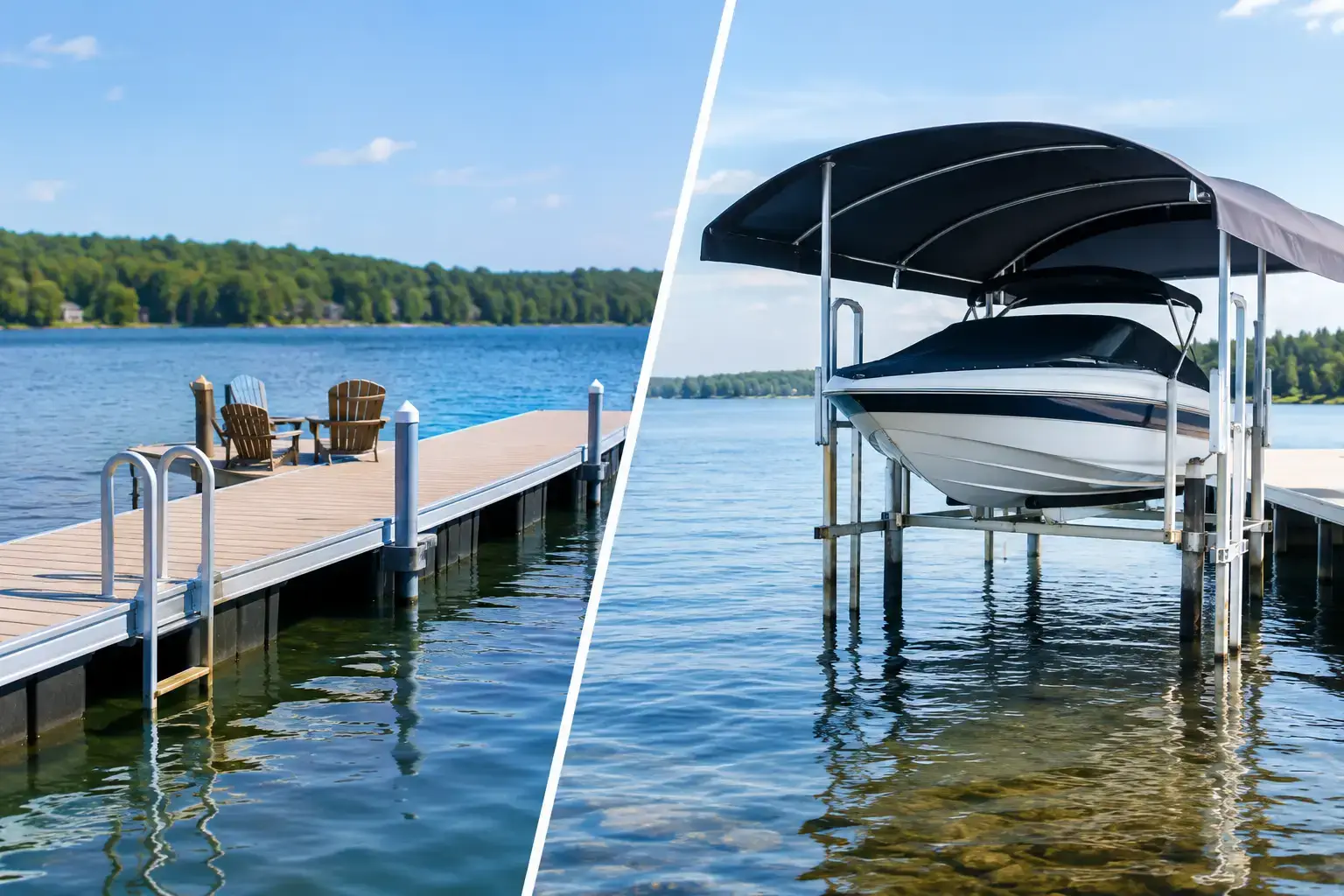
A floating dock is a stable, water-level platform that rises and falls with the water. It creates usable access for people, boats, personal watercraft, fishing, paddling, swimming, and shoreline activities. Modular floating dock systems can be configured into straight walkways, slips, T-docks, fishing platforms, kayak launches, floating boardwalks, and more.
A boatlift is designed primarily to raise a boat above the water when it is not in use. Depending on the system, it may use a fixed structure, pilings, cables, bunks, cradles, or a powered lifting mechanism. Its main purpose is vessel storage and protection, not broad waterfront access.
That distinction matters. A boatlift can be an excellent investment for the right boat and site, but it does not replace a dock. Likewise, a floating dock provides exceptional access but does not automatically keep a boat completely out of the water. Homeowners and operators who want both functions may pair a floating dock with a compatible boat port or a separately designed lift system.
When a Floating Dock Is the Better Fit
Floating docks are especially well suited to reservoirs, lakes, ponds, and waterways with changing water levels. As the water rises or drops, the dock moves with it, keeping the walking surface close to the waterline. That makes boarding, launching a kayak, or stepping onto a personal watercraft more consistent than it would be from a fixed platform that may sit too high above the water during low-water periods.
This adaptability is a major advantage across Texas, Oklahoma, Arkansas, and New Mexico, where shoreline conditions and lake levels can change significantly through the year. A properly engineered floating system still needs the right gangway, anchoring, and stabilization plan, but its basic design is built around movement rather than fighting it.
A floating dock also makes sense when the waterfront must serve more than one activity. A family may want a swim ladder for kids, railings for older guests, a shaded seating area, a kayak launch, and room to tie up a fishing boat. A campground may need canoe access, rental boat staging, and a durable walkway that handles regular guest traffic. A public park may need a fishing pier, accessible route, and a protected launch area.
Modularity is another benefit. A dock layout can be expanded, reconfigured, or upgraded as needs change. Add a PWC port when a new watercraft arrives. Create a wider platform for fishing. Extend the walkway when water conditions require more reach. This flexibility can protect the long-term value of the investment, especially for properties expected to evolve over the years.
What a Floating Dock Requires
A floating dock is not a one-size-fits-all purchase. The dock, gangway, anchoring method, shoreline grade, water depth, wind exposure, and expected loads all affect the final design. On deeper or more exposed water, stabilization becomes particularly important for a secure feel underfoot.
Material quality matters as well. Low-maintenance polyethylene dock sections are designed to stand up to sun, moisture, and regular use without the recurring staining, splintering, and board replacement associated with many traditional wood docks. For busy residential properties and public-use locations, a slip-resistant surface and well-planned access points contribute directly to safer use.
When a Boatlift Makes More Sense
A boatlift is most compelling when keeping one boat dry is the top priority. Raising a vessel out of the water can reduce long-term exposure to algae, marine growth, waterline staining, and hull-related maintenance. It can also provide more peace of mind for owners who leave a boat in the slip for extended periods.
Boatlifts are often a practical choice for a dedicated boat slip with relatively predictable water conditions and a vessel that will remain in that location. They can be particularly valuable for owners of larger boats or premium vessels where regular cleaning, hull protection, and convenient storage justify the added equipment and site requirements.
However, a lift requires careful matching to the boat. The system must be rated for the vessel’s fully loaded weight, not simply its published dry weight. Hull configuration, beam, length, propulsion type, lift capacity, electrical service, and local water conditions all need to be considered. An undersized or poorly configured lift is not a bargain.
A boatlift may also involve more mechanical maintenance than a simple floating access platform. Cables, motors, switches, bunks, and moving components need routine inspection and service. In locations with big water-level swings, fixed or piling-based lift systems can become more complicated to use effectively, depending on their range and configuration.
The Boat Port Alternative for Floating Docks
For many recreational boaters, a floating boat port offers a useful middle ground. A port connects to the floating dock and provides a drive-on or float-on place to store a boat or personal watercraft closer to the water’s surface. Because the port moves with the dock, it can be a strong option where changing water levels make fixed elevation systems less convenient.
Boat ports are not identical to traditional boatlifts. They do not use the same elevated cradle-and-cable approach, and they are not the right answer for every vessel. Still, for compatible boats, PWCs, and smaller recreational watercraft, they can make launching and retrieval quick while providing protection from prolonged in-water storage.
This approach can also simplify a waterfront layout. Instead of building separate access and storage structures, the dock and port can operate as one coordinated system. For families that use boats, kayaks, paddleboards, and PWCs from the same shoreline, that integrated design is often more functional than dedicating the entire waterfront to a single lift.
Compare the Costs Beyond the Initial Price
The purchase price is only one part of the decision. A traditional boatlift may require a supporting structure, pilings or other foundation work, electrical components, and ongoing mechanical service. Installation complexity can increase quickly where water is deep, the shoreline is steep, or access for equipment is limited.
A floating dock system also has real design and installation costs, particularly when it includes a gangway, anchoring, accessories, and specialized configurations. Yet its modular construction can make phased expansion more realistic. Rather than committing to every feature immediately, an owner can begin with safe access and add boat storage, lighting, railings, or recreational features later.
Think about ownership costs, too. A low-maintenance dock can reduce the time spent repairing boards, tightening hardware, repainting surfaces, or managing corrosion-prone components. A lift may save on boat cleaning and hull maintenance, but its moving parts still require attention. Neither choice is maintenance-free. The goal is to select the maintenance profile that makes sense for your property and use pattern.
Start With Your Waterfront Conditions
Before selecting equipment, evaluate the site honestly. Measure typical and extreme water-level changes. Consider seasonal wind, waves, wakes, water depth, shoreline slope, soil conditions, and whether the property experiences debris or ice. Identify how people will reach the dock and whether the route needs to accommodate children, older adults, carts, fishing gear, or public users.
Then consider the actual vessel plan. Is the waterfront built around one boat, or will it support changing watercraft over the next decade? Do you need protected storage, or do you need a flexible place where people can gather and get on the water safely? Are you planning for a private lake home, a marina operation, or a public-access facility with higher traffic and durability demands?
These questions often reveal that the decision is not strictly floating dock or boatlift. The best design may be a floating dock with a boat port, a dock beside a dedicated lift, or a modular access system that leaves room for future storage upgrades.
EZ Dock Texas helps property owners, marinas, parks, and public agencies turn those site conditions into practical waterfront layouts. A customized design consultation can account for water movement, anchoring, access needs, intended use, and long-term expansion before equipment reaches the shoreline.
The right waterfront system should make it easier to use your property, not create a new set of limitations. Start with how people and boats will move through the space, then choose the dock, lift, or port configuration built to support that use for years to come.