Public dock safety standards in Texas are governed by a combination of the Texas Water Safety Act, ADA federal guidelines, and specific river authority rules (like the BRA or TRWD). Key standards include a 1:12 maximum slope for gangways, integrated edge protection for wheelchair safety, and 24/7 high-visibility lighting for structures extending more than 50 feet. Compliance is maintained through documented monthly inspections of anchoring systems, surface traction, and the stability of flotation units.
Key Takeaways:
- ADA compliance is mandatory for all public and community-association docks.
- Standardized 4-inch reflectors or lighting are required for nighttime navigation safety.
- Floating docks must maintain at least 40% of their flotation above the waterline.
- Separation of “User Zones” (swimming vs. motorized) is a core safety requirement.
- Meticulous inspection logs are the primary defense against municipal liability.
The Regulatory Landscape
In Texas, public dock safety standards aren’t found in a single book. Instead, they are a patchwork of requirements from the Texas Parks and Wildlife Department (TPWD), the U.S. Army Corps of Engineers, and regional water districts.
For a park manager, the “Gold Standard” is to meet the most restrictive of these rules. This not only ensures legal compliance but significantly hardens the facility against accidents. Whether you are overseeing a small community fishing pier or a major municipal marina, the following standards are your baseline for operational excellence.
Structural & Design Standards
1. ADA Accessibility (The 1:12 Rule)
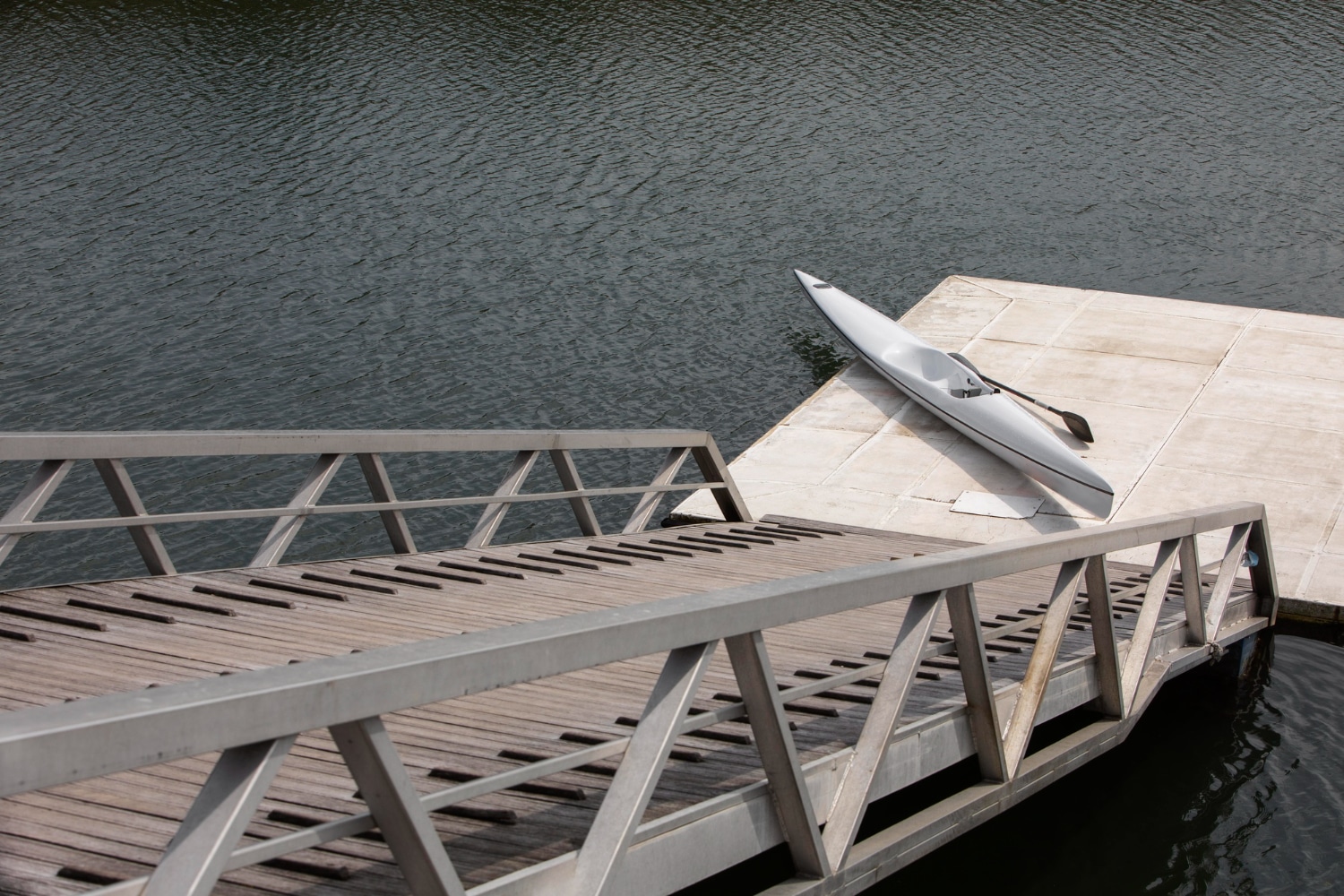
Federal law requires that public waterfronts be accessible. The most common point of failure is the gangway.
- The Slope: To be ADA-compliant, a gangway must not exceed a $1:12$ ratio (1 foot of rise for every 12 feet of length).
- Width: Pathways must be at least 36 inches wide, though 60 inches is recommended for high-traffic public areas to allow for two-way wheelchair traffic.
- Edge Protection: Docks must feature a 2-inch minimum “curb” or railing to prevent mobility devices from slipping off the edge.
2. Flotation & Stability
A “tippy” dock is a liability.
- The 40% Rule: At least 40% of a dock’s flotation depth must remain above the water at all times, even under load.
- Material Integrity: Texas standards generally prohibit metal-covered drums or unencapsulated foam, as these can sink or contaminate the water if punctured by debris or animals.
3. Navigation & Visibility
To prevent boat collisions, public structures must be visible 24/7.
- Reflectors: 4-inch reflectors should be placed on the outside edges of all floating facilities.
- Lighting: Any structure extending more than 50 feet into the water typically requires dusk-to-dawn lighting. In high-traffic lakes, specific amber or white navigation lights may be mandated by local authorities.
Operational Safety Standards
Zone Separation
One of the most critical public dock safety standards is the physical separation of incompatible activities.
- The 100-Foot Rule: Texas law often prohibits swimming or wading within 100 feet of public loading docks and boat ramps.
- Signage: Use high-contrast, icon-based signs to clearly mark “No Fishing from Docks” or “No Wake” zones.
Fire and Rescue Readiness
- Distance to Safety: In larger marinas, fire extinguishers must be housed in weather-protected cabinets and spaced so that no point on the dock is more than 75 feet from an extinguisher.
- Rescue Hubs: Every public dock should have a “Rescue Station” equipped with a U.S. Coast Guard-approved life ring and at least 50 feet of high-visibility throw line.
Maintenance & Inspection Protocol
Standardized inspections are what turn a “safe design” into a “safe facility.”
| Component | Frequency | What to Look For |
|---|---|---|
| Anchoring | Monthly | Frayed cables, loose piling brackets, or “travel” limits. |
| Decking | Weekly | Splinters, loose fasteners, or algae buildup (slip hazard). |
| Flotation | Quarterly | List (leaning), puncture marks, or excessive marine growth. |
| Gangways | Daily | Obstructions, loose handrails, or steep transition gaps. |
| Safety Gear | Weekly | Missing life rings or expired fire extinguishers. |
FAQ
Do we need a permit for “repairs” to a public dock?
In many Texas cities (like Austin), even substantive repairs require a building permit to ensure the structure is brought up to current public dock safety standards.
What is the “Texas Water Safety Act”?
It is the primary state law (Chapter 31 of the Parks and Wildlife Code) that governs boat operation, required safety equipment, and the markers used in public waters.
Are solar lights sufficient for navigation safety?
Usually, yes, provided they are marine-grade and remain lit from dusk until dawn. Check with your local river authority for specific color or lumens requirements.
How do we handle “overcrowding” on a public dock?
Post “Maximum Occupancy” signs based on the dock’s buoyancy rating. If a dock begins to sit low in the water (less than 40% freeboard), it is over capacity and becomes a safety hazard.
Is glass allowed on public docks?
No. Most Texas water authorities (BRA, NPS) strictly prohibit glass containers within 100-200 feet of the shoreline to prevent injury to swimmers and waders.
Who is responsible if a visitor gets a splinter on a wood dock?
If the park failed to maintain the surface, the municipality could be held liable for “known dangerous conditions.” Transitioning to composite or HDPE materials eliminates this risk.
Checklist for Park Managers
- [ ] Verify all gangways meet the 1:12 slope requirement.
- [ ] Ensure 4-inch reflectors are installed on all lakeward corners.
- [ ] Check that life ring stations are unobstructed and fully equipped.
- [ ] Conduct a “barefoot test” on decking to check for heat and splinters.
- [ ] Confirm that “No Swimming” signs are visible from the boat ramp.
- [ ] Update the digital maintenance log with this week’s inspection.
- [ ] Test all emergency lighting systems for night-time visibility.
- [ ] Audit PFD (Life Jacket) loaner stations for size variety and condition.
- [ ] Review the “Duty of Care” statement in the park’s operational manual.
Upholding public dock safety standards is a continuous commitment to your community’s well-being. By implementing these tactical standards, you move your department from a reactive posture to a proactive safety culture. At EZ Dock Texas, we provide modular solutions engineered to meet and exceed these rigorous standards, from ADA-compliant launches to ultra-stable floating platforms. Need a professional safety audit of your current waterfront? Contact us today or see our safety-first designs in action on Facebook.