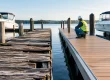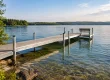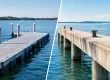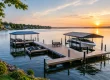
A successful community fishing area balances accessible infrastructure with healthy underwater ecosystems. Best practices include installing stable, low-profile floating piers that allow for safe casting, adding submerged “fish attractors” (like cedar cribs or PVC cubes) near the docks to concentrate fish, and ensuring the shoreline has steep slopes (>4 feet) to deter wading birds while providing safe, flat “staging areas” for families.
Key Takeaways:
- Stable floating docks provide the best casting platforms for children and seniors.
- Submerged habitats (brush reefs) keep the fish where the people are.
- Integrated “fishing rails” and benches increase the comfort and “dwell time” of residents.
- Use light-colored, heat-resistant decking to make mid-day fishing comfortable.
- Catch-and-release programs and “Fishing Line Recycling” bins protect the resource.
The Value of a “Fishing First” Design
For many Texas HOAs and municipal parks, a pond is often just a stormwater management tool. However, by intentionally designing a community fishing area, you transform a utility into a lifestyle amenity. A well-planned fishing spot encourages multi-generational interaction, provides a low-cost recreational outlet for residents, and significantly boosts property values.
The Science of “Attracting” the Experience
You can’t have a great fishing area without fish. For a small community pond, this means creating “structure.” Fish like bass and sunfish are “ambush predators”—they want to hide near something. By placing habitats directly under or adjacent to your docks, you ensure that even a novice angler has a high chance of a “catch,” which is the key to community engagement.
Design Best Practices
1. The Floating Advantage
Unlike fixed piers, floating docks stay at the perfect height for landing a fish, regardless of how much the pond level fluctuates.
- The “T-Head” Shape: This is the gold standard for community fishing areas. The long “stem” gets anglers away from shoreline weeds, while the wide “cross-bar” provides plenty of space for multiple families to fish without tangling lines.
- Stability: Choose a dock with a high “pounds-per-square-foot” buoyancy rating to prevent the pier from “rolling” when someone walks to the edge to net a fish.
2. Habitat Integration
To keep the fishing exciting, work with Texas Parks and Wildlife (TPWD) or a lake management consultant to install:
- Cedar Cribs or Brush Reefs: These provide cover for small forage fish, which in turn attracts larger game fish.
- Gravel Beds: Placing 5–6 inches of river gravel in 2–4 feet of water near the pier creates a “spawning bed” that keeps sunfish (perch) in the area all summer.
3. Shoreline Safety and Accessibility
- The “Safety Bench”: If your pond has steep banks for bird control, create a flat, 6-foot-wide “bench” of turf or crushed granite right at the water’s edge for the dock transition.
- Fishing Rails: Install railings that are 34 inches high—low enough for a seated angler or a child to cast over comfortably, but high enough to provide a safety barrier.
Maintenance & Operations Plan
- Monthly: Inspect the “Fishing Line Recycling” bins. Monofilament is deadly to local birds and turtles if left on the ground.
- Quarterly: Audit the shoreline for invasive vegetation (like Cattails or Hydrilla) that might block access to the water.
- Annually: Host a “Youth Fishing Derby” to build community interest and test the health of the fish population.
FAQ
How deep should our community fishing pond be?
Ideally, at least 8–10 feet in the center to provide a “cool zone” for fish during Texas summers, with 3–5 feet around the fishing docks.
What are “fish attractors”?
They are man-made structures (PVC pipes, weighted Christmas trees, or rock piles) placed underwater to give fish a place to hide and hunt.
How do we stop people from keeping too many fish?
Post clear “Catch and Release Only” or specific “Bag Limit” signs at the entrance to the dock. This is the only way to prevent a small pond from being “fished out” in a single season.
Are floating docks safe for small children?
Yes, especially those with integrated non-slip surfaces and safety railings. They are far more stable than the “wobbly” wooden piers of the past.
Can we turn a retention pond into a fishing area?
Usually, yes. You just need to ensure the water quality is managed and that the dock anchoring can handle the “surge” of water during a heavy rain.
Checklist for HOA Boards
- [ ] Verify the pond’s depth and water quality with a biologist.
- [ ] Select a modular dock system that can be expanded later.
- [ ] Plan for at least two submerged “fish attractors” within 15 feet of the dock.
- [ ] Install a “Fishing Line Recycling” station at the dock entrance.
- [ ] Ensure the path from the sidewalk to the dock is ADA-accessible.
- [ ] Add a shaded bench or pavilion near the fishing area for parents/grandparents.
- [ ] Order custom “Community Fishing Rules” signage.
- [ ] Budget for an annual “Stocking Program” to keep the population healthy.
A community fishing area is one of the highest-ROI amenities an HOA or park can offer, providing a peaceful connection to nature just steps from home. At EZ Dock Texas, we specialize in designing and installing the infrastructure that makes these spaces successful—from ultra-stable piers to accessible kayak launches. Ready to cast a line into your next community project? Contact us today or follow our latest HOA transformations on Facebook.