Modern boat launch design prioritizes “throughput efficiency” by separating preparation, launching, and queuing activities. Key features include 20-to-30-foot-wide ramps with a $12\%–15\%$ grade, integrated “queuing docks” that allow boaters to wait out of the navigation channel, and dedicated “staging zones” where trailers are prepped before reaching the water. In 2026, the gold standard involves modular floating systems that adapt to water levels and specialized non-motorized zones to eliminate conflicts between powerboats and paddlers.
Key Takeaways:
- Queuing docks are the #1 tool for reducing ramp congestion and verbal conflicts.
- “Power loading” protection (riprap or reinforced toes) is vital for long-term ramp integrity.
- ADA-accessible boarding piers are now a standard expectation for municipal grants.
- Staging areas located 100+ feet from the ramp prevent “launch-line” bottlenecks.
- Floating docks offer superior safety over fixed piers in fluctuating Texas reservoirs.
Suggested Featured Image: A multi-lane concrete boat ramp with a central floating queuing dock and a clear “Preparation Zone” with signage.
Search Phrases: efficient boat ramp layout, modern public boat launch, queuing dock for boaters.
Solving the “Saturday Morning” Bottleneck
For most Texas parks, the boat ramp is the single highest-stress area. Traditional designs often force boaters to prep their gear, launch their vessel, and wait for their driver all in one tight space. Modern boat launch design treats the launch as a three-stage industrial process: Stage 1: Prep, Stage 2: Launch, and Stage 3: Queue.
By physically separating these stages, parks can double their “launch-per-hour” capacity without adding a single extra ramp lane.
Best Practices in Modern Layout
1. The Power of the Queuing Dock
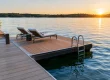
A queuing dock is a floating pier adjacent to the ramp where boaters can tie up temporarily after launching.
- The Benefit: It allows the driver to park the trailer without the boat drifting or blocking the ramp lane.
- Design Note: In high-traffic areas, queuing docks should be at least 40–60 feet long to accommodate multiple vessels simultaneously.
2. Protecting the Ramp “Toe”
One of the most expensive repairs in waterfront management is “scour” at the bottom of the ramp caused by boat propellers.
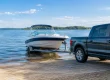
- Power Loading: Most modern boaters “drive” their boat onto the trailer. This creates a hole at the end of the concrete.
- The Solution: Modern designs extend the concrete ramp to a depth of at least 5 feet or install a “riprap apron” of heavy stones at the submerged end to dissipate energy.
3. Integrated ADA Boarding
Accessibility is no longer an “extra.” Modern boat launch design incorporates a boarding pier with a $1:12$ slope gangway.
- Universal Benefit: An ADA-compliant pier isn’t just for wheelchairs; it provides a stable, safe platform for seniors and families with small children to board the vessel away from the slippery incline of the ramp itself.
[Image showing a clear diagram of a 3-lane boat ramp with staging area, ramp, and queuing docks]
Managing Motorized vs. Non-Motorized Traffic
In 2026, the explosion of kayaking and paddleboarding has created a new challenge. Mixing a $20$-foot bass boat with a $10$-foot kayak in the same lane is a major safety risk.
- Segregated Launches: If space allows, place a dedicated “paddlesport launch” at least $100$ feet away from the motorized ramp.
- Visual Demarcation: Use safety buoys to create a “human-powered lane” that keeps paddlers out of the prop-wash and blind spots of backing trailers.
Maintenance & Operations Plan
- Weekly: Pressure wash the “splash zone” of the ramp to remove slippery algae.
- Monthly: Inspect the rollers and bumpers on the queuing docks to prevent hull damage.
- Annually: Conduct a “depth survey” at the ramp toe to ensure no scour holes are forming.
- Seasonally: Check that all “Launch Protocol” signage is legible and not obscured by summer foliage.
FAQ
What is the ideal slope for a boat ramp?
Most experts recommend a grade of 12%–15%. If the ramp is too flat, the tow vehicle must back too far into the water; if it’s too steep, traction becomes an issue.
How do we stop “Ramp Rage”?
The best deterrent is a “Preparation Zone.” Force boaters to stop at a staging area before the ramp to remove tie-downs and load coolers. This ensures that when they hit the ramp, they are “ready to drop.”
Are floating docks better than fixed piers for launches?
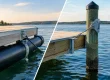
Yes. Fixed piers often become too high or too low to be useful. Floating docks remain at a constant height relative to the boat, making it easier for people to step in and out.
How wide should each ramp lane be?
A minimum of $15$ feet is standard, but $20$ feet is preferred for public parks to account for varying driver skill levels.
Can we build a boat launch in a high-current area?
It’s not recommended. Launches should be located in coves or “eddies” where the water is calm. If a current is unavoidable, the ramp must be angled downstream.
Checklist for New Launch Planning
- [ ] Conduct a traffic study of peak-day usage.
- [ ] Designate a “Staging Area” with at least $100$ feet of clearance from the ramp.
- [ ] Include at least one floating queuing dock per two ramp lanes.
- [ ] Verify the ramp toe is protected against prop-wash erosion.
- [ ] Ensure the gangway to the boarding pier is ADA-compliant.
- [ ] Install high-visibility navigation buoys to mark the launch channel.
- [ ] Add a “Boat Wash” station to prevent the spread of invasive species.
- [ ] Plan for solar-powered overhead lighting for 24/7 safety.
- [ ] Check that the parking lot has “pull-through” spots at least 40-50 feet long.
- [ ] Review local environmental codes for “soft-bottom” habitat protection.
A well-designed boat launch is the “front door” of your park. By investing in modern boat launch design, you reduce maintenance costs, improve safety, and ensure that a day on the water starts with a smile, not a shout. At EZ Dock Texas, we provide the modular queuing docks and accessible piers that make these facilities world-class. Ready to upgrade your park’s throughput? Contact us today or see our latest launch projects on Facebook.