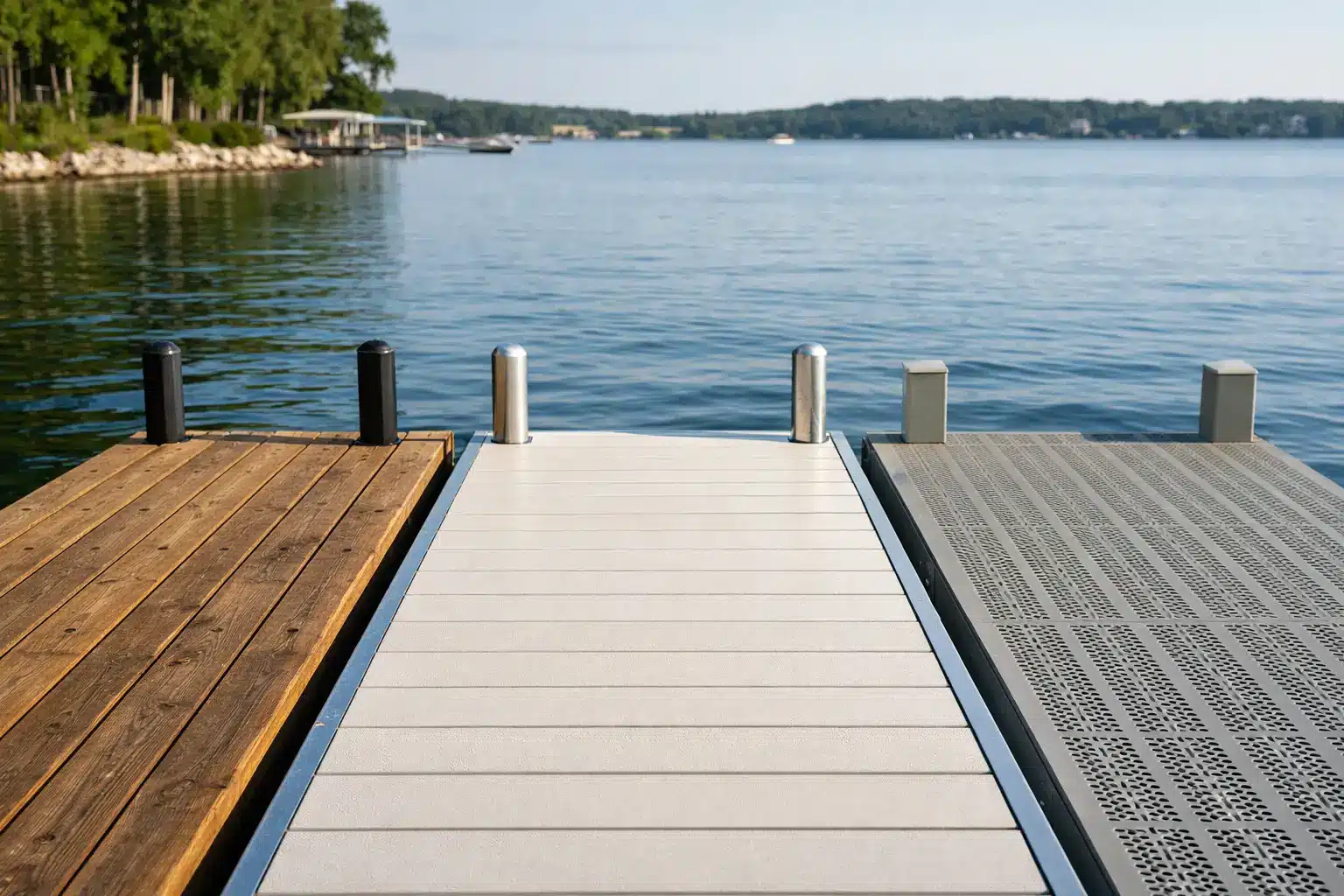
A dock can look great on installation day and still become a constant repair project a few seasons later. For waterfront owners asking which dock materials last longest, the better question is often: which material will last longest in your water conditions, with the level of maintenance you are willing to perform? Sun exposure, wave action, water-level changes, ice, traffic, and anchoring all affect the answer.
For many lakefront homes, marinas, parks, and public-access sites, a high-quality modular polyethylene floating dock offers the strongest long-term combination of durability, low maintenance, and adaptability. That does not make every other dock material a poor choice. Wood, aluminum, and composite decking each have a place, but their long-term performance depends heavily on how the dock is built and used.
Which Dock Materials Last Longest in Real Conditions?
Material life is not just about whether a deck surface can survive outdoors. A dock is a system: flotation, frame or structure, decking, connections, anchoring, and access points all need to work together. The longest-lasting dock is usually the one engineered for the site rather than a collection of components selected independently.
In broad terms, rotomolded polyethylene floating dock systems typically provide the longest service life with the least routine upkeep. Aluminum-framed docks can also last for decades, especially in the right environment, but their decking, hardware, and flotation still need attention. Composite deck boards may outlast untreated wood, while wood remains a traditional, familiar choice that requires the most consistent care.
Polyethylene modular floating docks
Rotomolded polyethylene docks are made as molded sections with foam-filled interiors. The outer shell is built to resist impact, moisture, insects, and rot, which eliminates several common failure points found in conventional wood dock construction.
Because the dock sections float, they rise and fall with changing water levels. That matters on reservoirs and lakes where seasonal drawdowns, storms, and rainfall can make a fixed-height dock difficult to use. Modular sections can also be configured around boat slips, swim areas, fishing access, kayak launches, personal watercraft ports, and changing family or operational needs.
A properly designed polyethylene dock does not need staining, sealing, or painting. Cleaning is generally limited to rinsing debris and addressing surface buildup as needed. UV-stabilized materials help the dock tolerate intense sun exposure common across Texas, Oklahoma, Arkansas, and New Mexico.
No material is maintenance-free. Connection hardware, anchoring components, gangways, and accessories should still be inspected periodically. But the primary dock surface and flotation structure are designed to avoid the rot, splintering, and corrosion issues that drive many long-term repair costs.
Aluminum docks
Aluminum is light, strong, and naturally corrosion-resistant, making it a popular choice for both floating and fixed dock frames. A well-built aluminum frame can deliver a long service life, particularly in freshwater applications where the dock receives proper maintenance.
Its biggest advantage is structural efficiency. Aluminum docks can be easier to handle than steel-framed systems, and many owners appreciate their clean appearance. However, aluminum is not automatically a low-maintenance solution. Fasteners and mixed-metal connections must be selected carefully to reduce galvanic corrosion. The deck surface, flotation, and moving parts may also wear out before the frame does.
Aluminum can become uncomfortably hot under direct summer sun. Its surface can also be slick when wet unless the decking is designed with traction in mind. For high-traffic public access, swimming areas, and barefoot recreation, those details deserve attention during design.
Composite decking over a dock frame
Composite decking is often chosen for its familiar boardwalk appearance and resistance to rot. It does not need the same repeated staining and sealing cycle as wood, and it can hold its color better than many natural boards.
Still, composite is a decking material, not a complete dock structure. It must be supported by a frame, and the life of the overall dock depends on that frame, the flotation, the fasteners, and the connection points. Some composite boards can retain heat, become slippery with algae or moisture, or show surface wear in busy commercial settings.
Composite can be a sensible option for fixed piers, elevated walkways, and dock areas where a traditional plank look is a priority. It may be less practical when low weight, easy reconfiguration, and frequent water-level changes are central concerns.
Pressure-treated wood docks
Wood docks remain common because lumber is familiar, readily available, and often less expensive at the start of a project. Pressure-treated lumber is more resistant to decay than untreated wood, but it is not immune to the waterfront environment.
Wood expands, contracts, checks, splinters, fades, and can eventually rot. It may need periodic cleaning, sealing, board replacement, and fastener inspection. The underside of a wood dock can be especially difficult to maintain because moisture remains trapped around framing and connections.
A wood dock can serve a property well when it is properly constructed, regularly maintained, and installed in a suitable setting. But for owners seeking the lowest long-term maintenance burden, wood rarely comes out ahead of quality polyethylene or aluminum-based systems.
Longevity Depends on More Than the Surface Material
A durable dock can fail early if it is undersized, poorly anchored, or not matched to the shoreline. Before selecting materials, consider the forces your dock will face throughout the year.
Water-level fluctuation is a major factor. A fixed dock may work well at a stable pond or controlled shoreline, but it can become too high or too low on lakes with significant seasonal changes. Floating systems are usually better suited to variable water because the usable dock surface stays near water level.
Wave exposure matters too. Wind fetch, boat wake, and open-water conditions can place repeated stress on dock connections and anchors. A protected cove may allow a lighter configuration than an exposed marina shoreline. The correct anchoring approach – whether cables, piling guides, deadweight anchors, or another engineered solution – is as important as the dock material itself.
Traffic also changes the design. A private fishing dock used on weekends has different requirements than a municipal launch, campground marina, rowing facility, or rental operation. Public and commercial docks need durable walking surfaces, dependable handrails, accessible transitions, and components that can handle repeated use without becoming a liability.
Comparing Long-Term Cost, Not Just Purchase Price
The least expensive dock on day one is not always the least expensive dock over 15 or 20 years. Replacing boards, refinishing surfaces, repairing rot, and modifying a dock after water levels shift can turn a lower initial price into a larger ownership cost.
Wood often has the lowest initial material cost, but it usually carries the highest recurring maintenance commitment. Aluminum can have a higher upfront price while providing a long-lasting structural base, though its supporting components must be maintained. Composite can reduce deck-surface upkeep but may add weight and cost. Polyethylene modular docks often require a larger initial investment than a basic wood dock, yet their low-maintenance design and ability to expand or reconfigure can create stronger long-term value.
For properties that may evolve, modularity has real financial value. A homeowner may add a boat port later. A marina may need more slips. A park may need an accessible kayak launch or a wider boarding area. With a modular dock system, those changes can often be made without starting from scratch.
How to Choose the Right Long-Lasting Dock Material
Start by defining how the waterfront will be used five or ten years from now, not just this season. Consider whether the dock needs to support boats, personal watercraft, swimming, fishing, paddling, public access, or all of the above. Then assess water depth, shoreline grade, exposure, seasonal fluctuation, and the access route from land to dock.
For a low-maintenance residential dock on a fluctuating lake, a polyethylene floating system is often the practical choice. For a traditional fixed pier where appearance and plank-style decking are priorities, composite or well-maintained treated wood may fit. For applications needing a lightweight metal frame or a specialized structural layout, aluminum can be appropriate when paired with quality decking, flotation, and hardware.
Working with an experienced dock designer helps prevent material decisions from being made in isolation. EZ Dock Texas evaluates the full waterfront system, including layout, gangway access, anchoring, water conditions, and future expansion, so the finished dock is built for the property rather than simply delivered to it.
The material that lasts longest is the one that matches the environment and is supported by sound design. Choose a dock system that can handle your water, your traffic, and the way your waterfront will change over time – then you can spend more time using the dock than repairing it.