A dock that sits perfectly at the waterline in March can become a long step down by late summer – or disappear beneath a rising lake after a storm. That is the practical question behind fixed vs floating docks. The right choice is not simply about appearance or initial price. It comes down to water-level changes, bottom conditions, intended use, local requirements, and how you expect the property to serve your family, guests, customers, or community over time.
For many waterfront owners across Texas, Oklahoma, Arkansas, and New Mexico, changing reservoir levels make that decision especially important. A dock should provide dependable access when conditions are ideal and when they are not.
How Fixed Docks Work
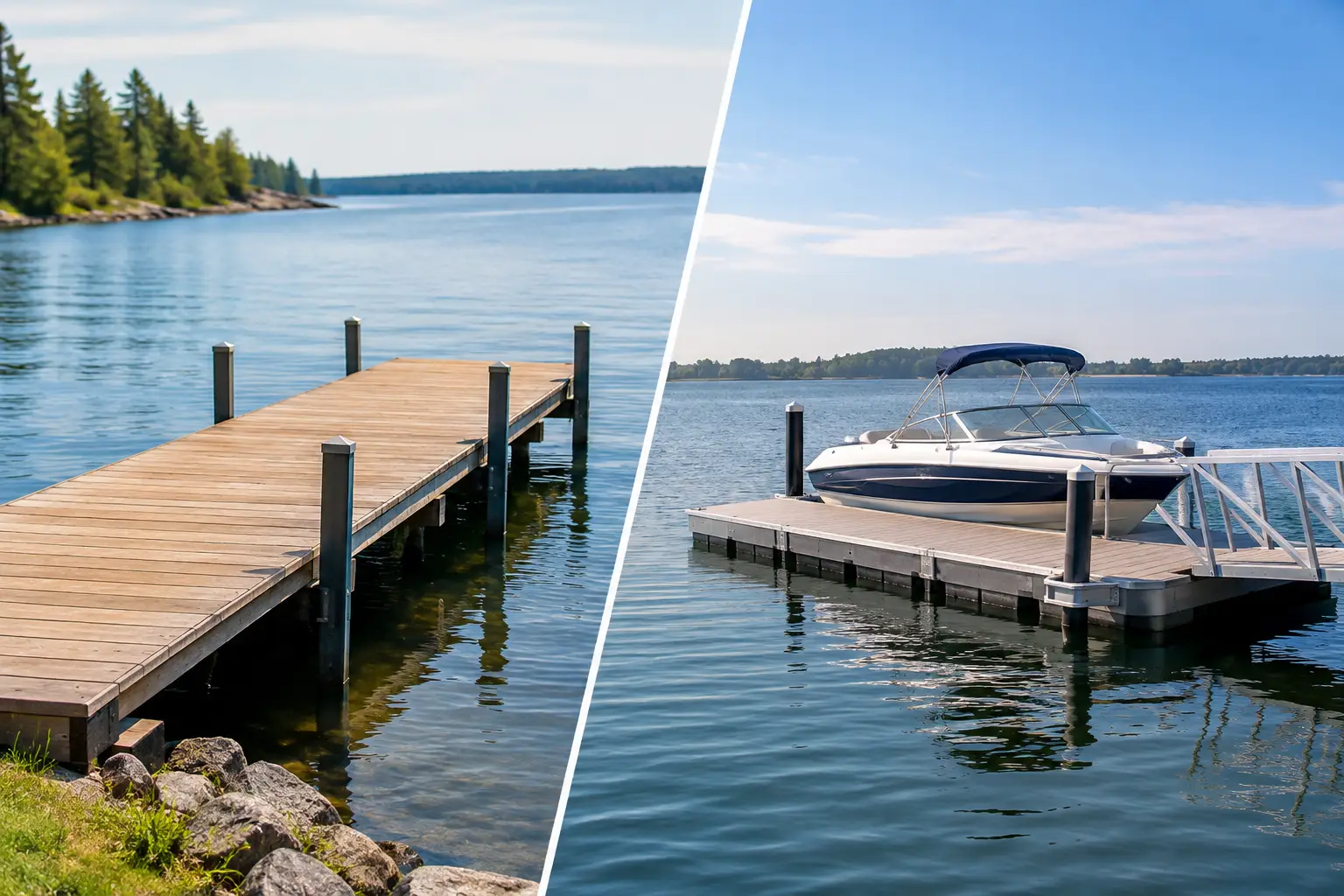
A fixed dock is built on permanent pilings driven or set into the lakebed, riverbed, or shoreline. Its deck remains at one elevation, regardless of the water level. Traditional fixed docks are commonly built with wood, steel, aluminum, or composite decking and are often selected where water levels stay relatively consistent and the shoreline has suitable conditions for piling installation.
The primary benefit is a solid, stationary feel. A well-built fixed dock can be a good fit for calm water, shallow areas, and properties where the deck must meet a fixed shoreline elevation. It can also complement a permanent pier, boathouse, or waterfront structure designed around a stable waterline.
That stability has limits. When water drops, the distance from deck to boat can become awkward or unsafe. When water rises, the dock surface may sit too close to the water or, in severe conditions, become submerged. Fixed structures also depend heavily on the condition of the pilings. Erosion, shifting soils, wave action, ice, debris, and changing lake bottoms can affect their long-term performance.
Installation is another major consideration. Driving pilings and working over water may require specialized equipment, suitable access from land or barge, and permits or approvals. Repairs can be more involved because the structure is permanently tied to the bottom rather than designed to be reconfigured section by section.
How Floating Docks Work
A floating dock rises and falls with the water. The dock sections rest on buoyant flotation and are connected to shore with a gangway, while anchoring systems hold the layout in place. Depending on the site, anchoring may use cables, pilings, pipe brackets, deadweight anchors, stiff-arm systems, or other engineered approaches.
This is why floating systems are often the practical choice for reservoirs, lakes, ponds, marinas, and waterfronts with seasonal or storm-driven level changes. The deck stays close to the water, maintaining more consistent access to boats, personal watercraft, kayaks, and paddleboards. A properly selected gangway adjusts with the dock, helping users move between shore and water safely as conditions change.
Modularity is another advantage. A floating dock can begin as a simple fishing or swim platform, then expand into a larger layout with boat ports, personal watercraft ports, kayak launches, benches, railings, ladders, lighting, dock boxes, or additional slips. If recreational needs change, the system can change with them.
Modern modular floating docks are not temporary or flimsy by default. High-quality American-made systems are engineered for long-term waterfront use, with durable materials that resist rot, splintering, and many of the maintenance demands associated with traditional wood construction. The anchoring and access design, however, are just as important as the dock sections themselves. A dock is only as reliable as the system that keeps it positioned and accessible.
Fixed vs Floating Docks: The Factors That Matter Most
Water variation is usually the deciding factor. If your lake, reservoir, river, or pond changes elevation throughout the year, a floating dock generally offers more dependable day-to-day access. Even modest changes can create an inconvenient step between a fixed deck and a boat. On highly variable water, that gap can become a safety concern.
Bottom conditions matter, too. Fixed docks require stable subsurface conditions that can support pilings. Rocky bottoms, deep water, soft sediment, steep shorelines, or areas with inconsistent lakebed conditions may make piling work difficult or costly. Floating systems are not free from site constraints, but they can be designed around many challenging shoreline and water-depth conditions through the right anchoring method.
Exposure to wind and wakes deserves careful attention. A protected cove places different demands on a dock than an open lakefront exposed to prevailing wind, boat traffic, and long fetch. Both fixed and floating docks need site-specific engineering and appropriate materials. Floating docks may require more substantial anchoring, wave attenuation, or layout adjustments in exposed locations. A fixed dock may resist movement at the deck level, but its pilings still absorb force from waves and debris.
Use also changes the answer. A stationary fishing pier or shoreline walkway may work well as a fixed structure. A boating family that wants consistent boarding height, a marina that needs flexible slips, or a park that serves kayakers and paddleboarders will often benefit from a floating layout. For public access sites, an appropriately designed gangway, railing package, and stable floating surface can support safer, more accessible waterfront entry.
Consider Maintenance as Part of the Purchase
Every waterfront structure needs periodic inspection, but the maintenance profile is different for each dock type. Fixed wood docks may require cleaning, sealing, replacing damaged boards, and monitoring for rot, fastener corrosion, and piling deterioration. The work can become more difficult when water levels are high or when components are far from shore.
Floating docks should be inspected for connection hardware, flotation condition, anchoring tension, gangway alignment, and wear from wave action or debris. With a modular system, individual sections and accessories can often be repaired, replaced, moved, or added without rebuilding the entire dock. That flexibility can reduce disruption and protect long-term value.
Low maintenance does not mean no maintenance. It means choosing materials and a system design that limit predictable headaches. For a home, ranch, resort, marina, or public facility, that can make a meaningful difference over years of use.
Access and Safety Should Lead the Design
Dock selection is often treated as a structural choice first and an access choice second. In practice, access should lead the conversation. Consider who will use the waterfront: children, older family members, anglers, renters, staff, emergency personnel, or visitors unfamiliar with the site. Consider how they will enter boats, launch kayaks, reach a swim ladder, carry gear, or move from shore after rain.
A floating dock keeps the deck at a more consistent relationship to the water, but the route from shore must be designed correctly. Gangway length, slope, width, handrails, transitions, and landing areas all affect safety. At low water, a gangway can become steep if it is too short. At high water, inadequate clearance or poor anchoring can create a different set of problems.
For commercial and public projects, accessibility requirements, building codes, utility needs, load capacity, and permitting should be addressed before equipment is ordered. Early planning avoids layouts that look good on paper but do not work for the site or the people using it.
When a Hybrid Approach Makes Sense
The choice does not always have to be entirely fixed or entirely floating. Many successful waterfronts use a fixed shoreline approach, retaining wall connection, or elevated walkway paired with a floating dock beyond the shore. This arrangement can provide a durable land-side transition while allowing the main dock to follow the water level.
A hybrid design is especially useful where the shore is steep, water levels fluctuate, or the property needs a clean connection from a patio, boathouse, parking area, or public trail. It can also make future expansions easier by separating the permanent shore infrastructure from the modular on-water layout.
Choose for the Conditions You Will Actually Have
The best dock is not the one that looks best on the first calm day after installation. It is the one that continues to provide safe, useful access through changing water, busy weekends, weather events, and evolving needs. Start with a site review that considers water history, shoreline grade, bottom conditions, wind exposure, intended users, and the equipment you want to support.
EZ Dock Texas helps property owners and organizations turn those details into customized waterfront systems, from anchoring and gangways to boat ports, launches, and accessible dock layouts. A thoughtful design now gives your waterfront room to work better for years to come.