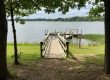
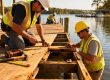
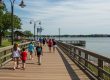
To prepare public docks for Texas heat, storms, and flooding, municipalities should utilize UV-stabilized, light-colored modular infrastructure that reflects heat and resists warping. Resilience is further enhanced by implementing “long-travel” anchoring systems—such as pile sleeves or elastic mooring cables—that allow docks to rise safely with floodwaters without detaching from the shoreline or sustaining structural damage.
Key Takeaways:
- Select high-density, light-colored materials to reduce surface temperature.
- Use flexible modular couplers to absorb wave energy during high-wind storms.
- Implement anchoring systems that accommodate at least 15–20 feet of vertical travel.
- Schedule pre-storm “tie-down” audits for all loose dock accessories.
- Prioritize UV-stable composites to prevent long-term sun-rot and brittleness.
Suggested Featured Image: A modular dock system floating securely during a high-water event, with dark storm clouds in the background.
The Reality of the Texas Environment
In the Lone Star State, waterfront infrastructure isn’t just fighting the water; it’s fighting the sky. Texas weather presents three distinct threats: the relentless UV radiation of 100-degree summers, the high-velocity winds of spring “dry lines,” and the massive “pulse” floods that can raise lake levels by a dozen feet in 48 hours.
To prepare public docks for Texas heat and other extremes, managers must move away from rigid, static designs. Resilience in the Texas context is synonymous with flexibility. Infrastructure that can move, breathe, and reflect energy—rather than fighting against it—will always outlast traditional construction.
Hardening Against the “Texas Trifecta”
1. Defeating the Heat
The Texas sun is a chemical engine that breaks down plastics and warps wood.
- Thermal Reflection: Dark materials can reach $70^\circ C$ ($158^\circ F$), causing structural expansion and safety hazards for bare feet. Light-colored HDPE (High-Density Polyethylene) stays significantly cooler.
- UV Stabilization: Ensure all polymers are “UV-8” rated or higher to prevent the “chalking” and brittleness that lead to cracked dock sections.
2. Storm and Wave Resilience
Thunderstorms on large Texas reservoirs can create 3-to-4-foot “fetch” waves.
- Dynamic Couplers: Traditional docks often snap at the joints during storms. Modular systems use rubber “dog-bone” couplers that allow the dock to flex and dissipate wave energy.
- Low Wind Profile: Minimize large vertical surfaces (like high-profile sides) that act as “sails,” putting unnecessary strain on anchoring points during 60 MPH gusts.
3. Flood-Proofing Your Assets
A fixed dock is a liability during a flood; once submerged, the upward buoyant force can pull pilings right out of the lakebed.
- Vertical Travel: Use “Pile Sleeves” or extra-long anchoring cables. If your lake has a historical flood stage of 15 feet above the conservation pool, your anchoring must be able to travel at least 18 feet.
- Self-Adjusting Gangways: Ensure gangways are on rollers or hinges that allow them to tilt upward safely as the dock rises.
Maintenance & Operations Plan
- Pre-Summer: Deep clean surfaces to remove dirt that absorbs heat. Check all “expansion joints” to ensure they haven’t seized.
- Pre-Storm Season (March/April): Tension all anchoring cables. Ensure all cleats are bolted through the frame, not just the decking.
- Post-Flood: Inspect for “tuck-under” (debris trapped under the dock) and verify that the anchoring hasn’t “walked” or shifted position.
- Monthly: Lubricate any moving metal parts (winches, sliders, or hinges) to prevent rust-seizing.
Budget & Planning Notes
- Insurance Implications: Many municipal insurance providers offer better rates for “certified resilient” infrastructure that meets specific wind and flood load ratings.
- The “Two-Decade” Math: While a storm-proof modular system might cost 20% more than wood, it avoids the $50,000+$ “rebuild cost” associated with a single major flood or wind event.
Safety & Liability Considerations
Weather-related damage often leads to hidden safety hazards.
- Floating Debris: After a storm, docks must be inspected for submerged logs that can puncture floats or create trip hazards.
- Electrical Safety: For docks with power, ensure all conduits are “liquid-tight” and that GFCIs are tested after any significant rain event.
FAQ
How do we stop our dock from floating away in a flood?
The key is “redundant anchoring.” Use a combination of land-based “stiff arms” and weighted lakebed anchors. This ensures that even if one cable snaps, the structure remains tethered.
What is the best material to prepare public docks for Texas heat?
High-density polyethylene (HDPE) with a high UV-inhibitor package. It doesn’t hold heat like aluminum and won’t splinter or warp like pressure-treated pine.
Can we “storm-proof” an existing wood dock?
You can improve it by adding “cross-bracing” and upgrading to marine-grade stainless steel hardware, but wood will always be more susceptible to storm damage than a flexible modular system.
How do we handle “ice” in North Texas?
While rare, ice can “heave” docks. Modular docks are naturally buoyant and usually “pop” up above the ice rather than being crushed by it.
What is a “Deadweight” anchor?
It is a large concrete block (often 500–1,000 lbs) placed on the lake floor. It’s the preferred method for Texas lakes with deep silt where pilings are difficult to drive.
How often should we adjust our anchor cables?
In Texas, check them whenever the lake level shifts by more than 3 feet. Cables that are too tight can snap; cables that are too loose allow the dock to slam against the shore.
Are solar lights safe during heavy rain?
Yes, as long as they are IP67 or IP68 waterproof rated. They are safer than 110V power during a flood because there is no risk of electrocution.
Checklist for Disaster Readiness
- [ ] Verify that all flotation units are securely fastened.
- [ ] Ensure anchoring pilings are tall enough for the 100-year flood level.
- [ ] Audit all “cleats” and “couplers” for stress fractures.
- [ ] Remove or secure “loose” items (benches, trash cans, ladders) before a forecast storm.
- [ ] Check that the “shoreline abutment” is reinforced against erosion.
- [ ] Test all emergency “shut-off” valves or switches for dock power/water.
- [ ] Inspect cable “swages” and “thimbles” for signs of fraying or rust.
- [ ] Update the emergency contact list for the local “Towing and Recovery” marine contractor.
- [ ] Confirm that all safety signage is “wind-rated” and securely mounted.
- [ ] Document the “As-Built” anchoring configuration for insurance records.
The Texas environment is unforgiving, but your waterfront doesn’t have to be a victim of the elements. By choosing to prepare public docks for Texas heat, storms, and flooding with resilient, modular infrastructure, you are protecting both your community’s budget and its recreational future. At EZ Dock Texas, we build our systems to endure the very best—and the very worst—of Texas weather. Ready to audit your park’s storm readiness? Contact us today or follow our weather-resilience tips on Facebook.