A floating dock is only as dependable as the system that holds it in position. When comparing pile guides versus deadweight anchors, the right choice comes down to more than preference. Water depth, lake-bottom conditions, seasonal fluctuations, wind exposure, permitting requirements, dock layout, and intended use all affect how a dock will perform over time.
For a lake home, marina, public launch, or park facility, the goal is the same: a dock that rises and falls with the water while staying where people expect it to be. Understanding how these two anchoring approaches work can help you plan a safer, longer-lasting waterfront system.
How Pile Guides Stabilize a Floating Dock
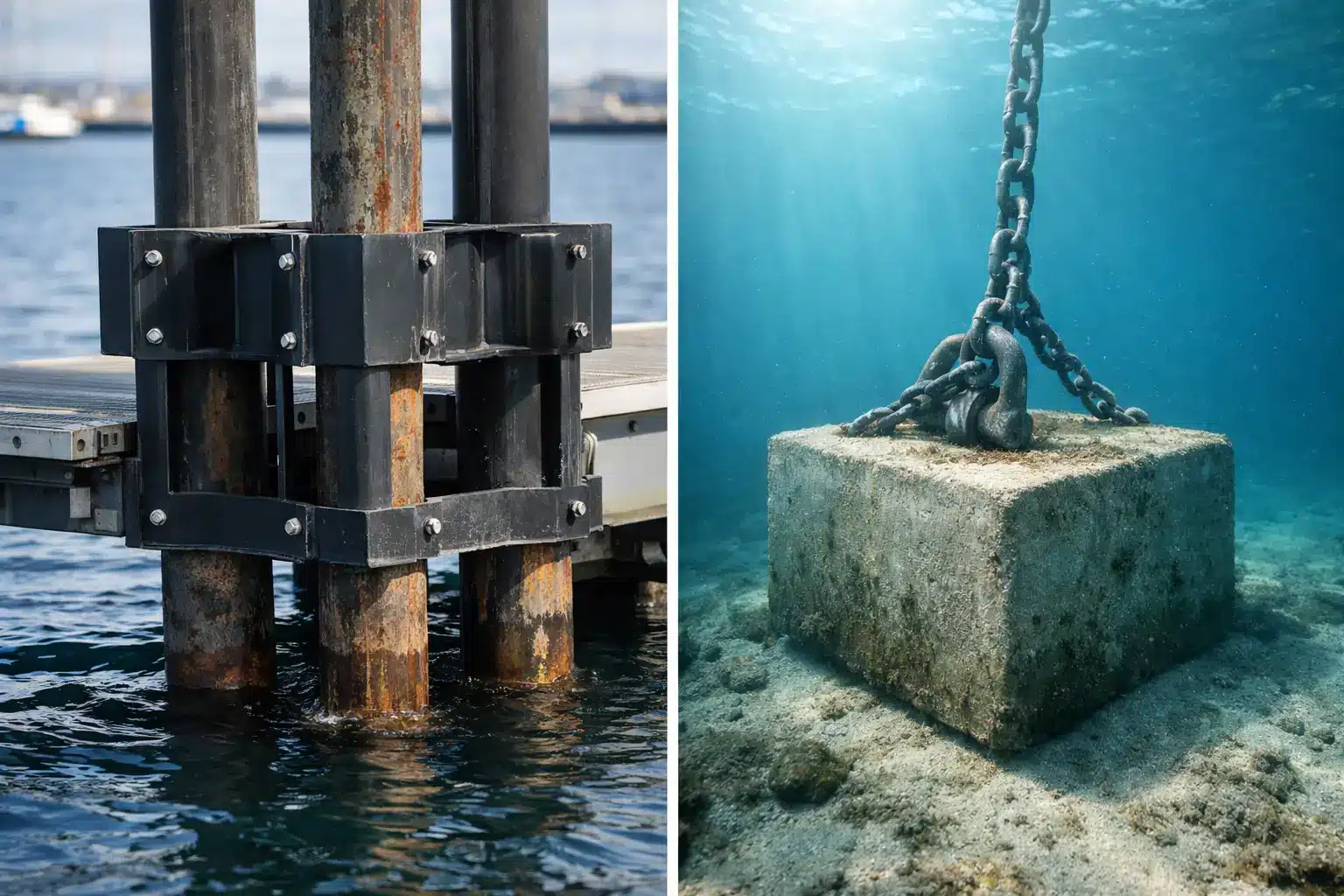
Pile guides secure a floating dock to vertical piles driven or installed into the lake or river bottom. The dock connects to sleeves or guide brackets that slide up and down the piles as water levels change. This gives the dock controlled vertical movement while limiting side-to-side drift.
On reservoirs and waterfronts with substantial water-level changes, that vertical travel is a major advantage. A properly designed pile system can keep the dock aligned with the shoreline connection, boat slips, and adjacent dock sections through changing seasons. Instead of relying on lines that may need regular adjustment, the dock remains guided by its fixed pile locations.
Pile guides are often selected where a firm, workable bottom can support piles and where the site needs precise positioning. They are a strong fit for marina slips, high-use fishing docks, public-access facilities, and residential layouts where a dock must stay consistently aligned with a gangway or shoreline landing.
Where pile guides perform best
Pile-guided systems are especially useful in protected or moderately exposed water where the bottom conditions are suitable for pile installation. They can provide excellent resistance to lateral movement from wind, waves, current, and normal boat traffic. For facilities with multiple slips or long runs of dock, that control can make access safer and day-to-day operations easier.
They also work well when a dock is expected to remain in one location for many years. Although installation requires careful planning and specialized equipment, the result can be a stable foundation for a permanent floating dock layout.
That does not mean piles are automatically the answer for every waterfront. Extremely deep water can make pile length, transport, installation access, and cost more challenging. Rock, hardpan, buried debris, or an unstable bottom may also limit whether piles are practical. In some locations, obtaining approval to install piles can add time to the project.
How Deadweight Anchors Hold a Dock in Place
Deadweight anchors use mass rather than vertical piles to resist dock movement. Typically, heavy concrete weights are placed on the lake bottom and connected to the floating dock with chains, cables, or other engineered tethering components. The anchors hold the system within a planned operating area while allowing it to move with changing water levels.
This approach is often a practical option in deeper water, on sites where driving piles is not feasible, or where a dock needs to be installed with less permanent disturbance to the bottom. Deadweight anchoring can be used for residential docks, floating swim platforms, temporary installations, rental docks, and certain commercial or municipal layouts.
The key is proper engineering. Anchor weight alone does not determine performance. The number of anchors, their placement, chain scope, water depth, dock size, anticipated wind load, wave conditions, and bottom material must work together. An undersized or poorly configured deadweight system can allow excessive drift, yaw, or stress at the gangway connection.
Where deadweight anchors make sense
Deadweight anchors can be a smart choice when the dock needs flexibility. They may be easier to reposition than piles if a layout changes, and they can accommodate sites where water depth makes pile installation impractical. They are also useful where a property owner or facility manager wants a floating system without permanently installing vertical structures into the bottom.
On fluctuating Texas reservoirs, however, the anchor lines or chains must be designed for the full expected range of water movement. A setup that looks secure at one water elevation may become too tight, too slack, or poorly angled at another. This is why anchoring should be considered alongside gangway length, shoreline access, and the dock’s normal operating water range.
Pile Guides Versus Deadweight Anchors: Key Differences
The most noticeable difference is how each system controls movement. Pile guides provide a fixed vertical path. The dock moves up and down, but the piles limit its horizontal travel. Deadweight anchors provide restraint through weight and tether geometry, so the dock generally has more allowable movement within its anchoring footprint.
That distinction affects the user experience. A pile-guided dock can feel more fixed underfoot and maintain a more predictable relationship to a boat slip or gangway. A deadweight-anchored dock may move more in wind or boat wake, even when it is functioning as designed. The amount of movement depends on site conditions and the anchoring design, not simply the anchor type.
Installation also differs. Pile systems usually require access for pile-setting equipment and a bottom that can accept the piles. Deadweight anchors require transporting and accurately placing substantial weight on the bottom, then configuring connection hardware for safe movement through the anticipated water range.
Long-term maintenance should be part of the decision as well. Pile guides and brackets should be inspected for wear, corrosion, fastener condition, and free movement. Deadweight systems need periodic checks of chains, shackles, cables, connection points, and anchor position. Neither option should be treated as install-it-and-forget-it equipment, particularly on high-use or exposed waterfronts.
Start With the Site, Not the Hardware
The best anchoring solution begins with a site evaluation. A homeowner may know the water depth at the end of the dock, but that is only one piece of the picture. The design team also needs to understand the water level at seasonal low and high points, the bottom composition, fetch across open water, common wind direction, wave action, shoreline configuration, and intended use.
A quiet private pond may call for a very different solution than a boat-active lake, marina basin, rowing venue, or public fishing pier. A dock serving kayaks and paddleboards has different movement and load considerations than one serving wake boats, rental fleets, or emergency-response access.
Permitting matters, too. Local lake authorities, utilities, property associations, municipalities, and state or federal agencies may have rules about pile placement, dock size, encroachment, navigation clearances, or bottom disturbance. Confirming those requirements before finalizing the design helps avoid costly changes after equipment has been ordered.
Match the Anchoring Method to the Dock’s Job
Choose pile guides when your priority is precise dock positioning, the bottom can support piles, and the site supports a more permanent installation. They are often the preferred approach for fixed slip layouts, busy public access points, and docks that need dependable alignment over a broad range of water elevations.
Choose deadweight anchors when deep water, bottom conditions, installation access, flexibility, or lower-impact placement make piles less desirable. A well-designed deadweight system can provide reliable restraint, but it should be sized for the actual dock, not selected as a one-size-fits-all add-on.
Some larger projects may use a combination of methods or additional stabilization components. The right answer depends on the site and the operational demands placed on the dock. A modular dock system makes it possible to adapt layouts over time, but the anchoring plan must be ready for the loads and movement those changes create.
Get the Dock and Anchor Plan Working Together
Anchoring should never be an afterthought added after the dock layout is chosen. The dock size, gangway location, freeboard, boat access, accessories, and anchor system need to be planned as one working waterfront design. That approach reduces unwanted movement, protects connections, and gives users a more confident path from shore to water.
EZ Dock Texas helps property owners, facilities managers, and public agencies evaluate these details before installation, from shoreline access through anchoring and final configuration. A customized design consultation can identify whether pile guides, deadweight anchors, or another stabilization approach best fits the water, the dock, and the people who will depend on it for years to come.