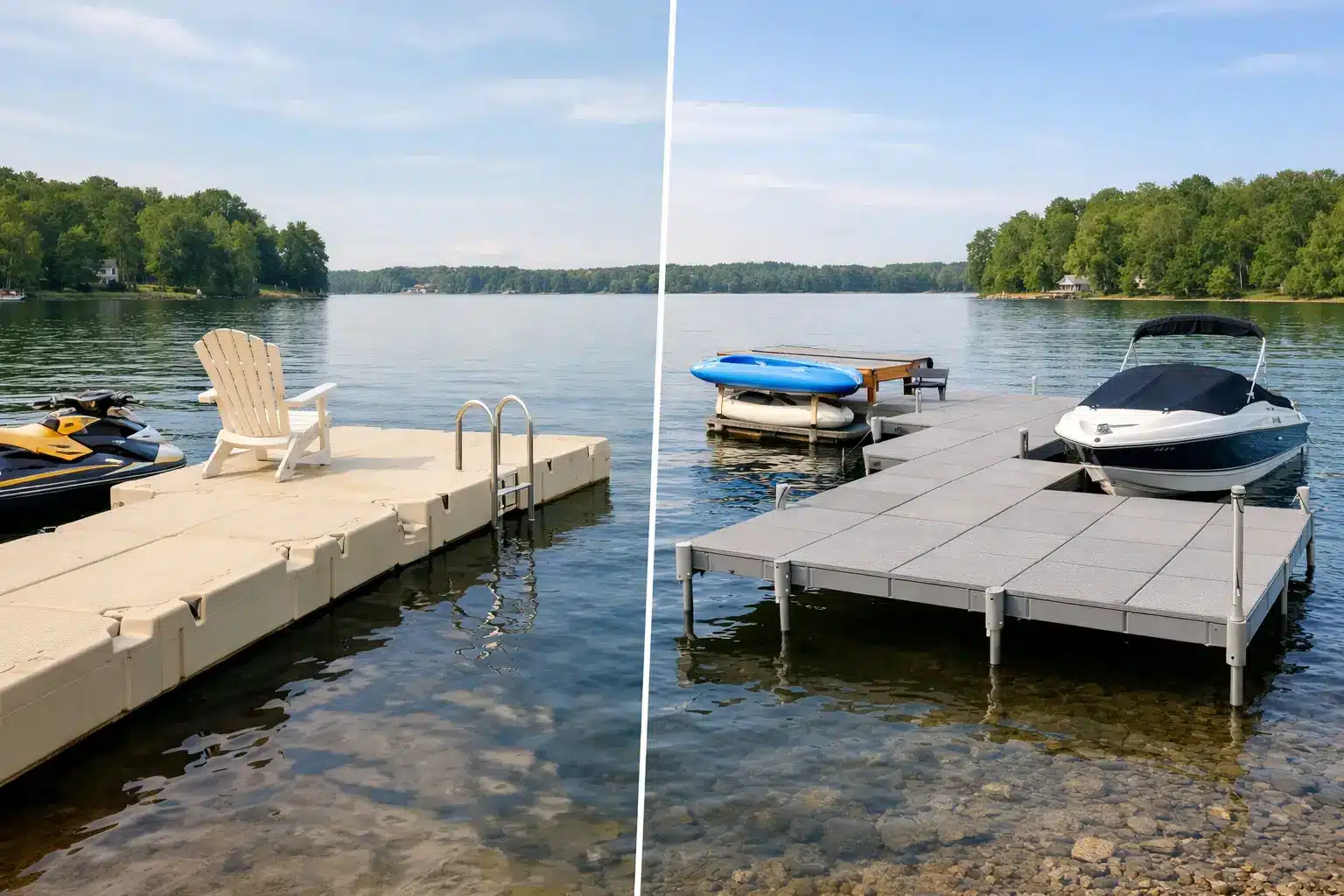
A lake dock has to handle more than weekend boat traffic. It may face changing reservoir elevations, wind exposure, muddy shorelines, summer heat, fishing gear, swimmers, and years of family use. When comparing EZ Dock vs modular dock systems for lake homes, the first point is worth clearing up: EZ Dock is a modular dock system. The more useful comparison is EZ Dock against other modular floating dock options and against the materials and construction methods behind them.
For many lake homeowners, the best choice comes down to how well a system fits the property now and how easily it can change with the way the family uses the water later.
EZ Dock vs Modular Dock Systems: What Is the Difference?
“Modular” describes a dock built from individual sections that connect to create a custom layout. Those sections can be arranged as a straight walkway, L-shape, T-shape, fishing platform, swim area, boat slip, or a larger gathering space. A modular layout can also be expanded, reconfigured, or relocated more easily than a fixed dock.
EZ Dock is a specific modular floating dock platform. Its polyethylene dock sections connect through a purpose-built coupling system, allowing the dock to flex appropriately with water movement while functioning as a unified structure. The system can be configured with gangways, anchoring, boat ports, personal watercraft ports, railings, ladders, lighting, and other accessories.
Other modular systems may use aluminum frames with composite decking, foam-filled floats, wood decking, plastic panels, or a mix of materials. Some are suitable for light residential use. Others are built for marina or public-access applications. The label alone does not tell you much about expected service life, traction, anchoring needs, or how the dock will perform in fluctuating water.
That is why homeowners should compare the complete dock system, not just the price of a dock section.
Start With Your Lake, Not the Catalog
The shoreline and water conditions should drive the design. A quiet private pond has different demands than a large Texas reservoir where water levels can shift substantially between seasons. Deep water, steep banks, rocky bottoms, wake exposure, and prevailing wind all affect the right layout and anchoring approach.
Floating docks are often a practical choice where water levels change. Rather than being locked to a fixed elevation, the dock rises and falls with the water. But the dock still needs a reliable way to stay positioned. Depending on the site, that can involve cable anchoring, pile guides, stiff-arm connections, deadweight anchors, or other engineered methods.
A lower-cost modular dock may look comparable on shore, yet its connection system, float capacity, or anchoring options may not be designed for the forces present on an exposed lake. A well-designed dock is not simply floating plastic or decking. It is a coordinated system of dock sections, access point, anchoring, and waterfront accessories.
Water-Level Changes and Shore Access
A floating dock only performs as well as its connection to land. If the lake level changes, a gangway needs adequate length and the right slope to maintain comfortable access. At some properties, the shoreline connection may require a transition platform or a more substantial approach structure.
This is especially relevant for homeowners who want aging family members, children, guests, or people carrying coolers and fishing equipment to reach the dock safely. Planning access at both typical and low-water conditions can prevent an otherwise good dock layout from becoming difficult to use.
Material Quality Shows Up Over Time
Most dock systems can look good when first installed. The longer-term differences tend to appear after years of sun, temperature swings, foot traffic, wet equipment, and repeated exposure to the lake environment.
EZ Dock sections are molded polyethylene, a material selected for low-maintenance waterfront use. The finished surface is designed to provide traction without the recurring staining, splintering, sealing, and board replacement often associated with traditional wood docks. For lake homeowners who would rather spend Saturday on the water than repairing decking, that maintenance profile matters.
Other modular docks may also offer durable materials, particularly higher-quality aluminum and composite systems. Aluminum-framed systems can be a strong choice when a project requires a more traditional deck appearance or specific structural dimensions. However, the homeowner should ask what is actually included: the grade of frame, flotation method, decking attachment, hardware, surface traction, and expected maintenance requirements.
The least expensive option can become costly if it needs frequent adjustments, replacement decking, damaged float repairs, or a full redesign when the family adds a boat or personal watercraft.
Layout Flexibility Is More Than a Nice Feature
Lake life changes. A homeowner may begin with a simple walkway and fishing platform, then add a pontoon boat, kayaks, paddleboards, or a personal watercraft. A growing family may want a larger swim area, while a property owner who hosts guests may need more room for seating and boarding.
This is where a true modular system earns its value. EZ Dock layouts can be built around current needs while leaving practical options for later expansion. A boat port can protect a boat from prolonged water exposure and make launching easier. A PWC port can keep a watercraft secure and accessible without the inconvenience of repeated trailering. Kayak and canoe launches can create a safer, more organized entry point for smaller watercraft.
Not every property needs every accessory. A compact lake cabin may benefit most from a simple floating walkway, ladder, and kayak launch. A primary residence with a pontoon boat and active swimmers may need a wider platform, boat port, railing in selected areas, and lighting for safe evening use. The right design is the one that supports the way the property is actually used.
Safety Depends on Details You Can See and Some You Cannot
Surface traction, edges, transitions, freeboard, handrails, and ladder placement all influence how safe a dock feels under bare feet. These details become more significant when children, older adults, pets, or guests are using the dock.
A floating dock should provide a stable, predictable walking surface and a clear route from shore to water. The placement of a swim ladder matters. So does the location of cleats, bumpers, mooring points, and any railings. An open platform can be ideal for fishing and swimming, but railings may be appropriate near an access point or in areas where users need extra support.
Below the surface, anchoring is just as important. A dock that drifts, twists, or repeatedly contacts the shoreline is not only frustrating – it can create wear and safety concerns. Professional site evaluation helps match the anchoring approach to water depth, bottom conditions, exposure, and the dock’s intended load.
Installation Support Can Protect the Investment
Some homeowners are comfortable assembling a small modular dock themselves, particularly on protected water with straightforward access. For more complex lakefront projects, professional planning and installation can prevent expensive corrections later.
A qualified dock partner can evaluate the shoreline, establish a layout that works with local conditions, plan for water-level movement, select appropriate anchoring, and coordinate accessories before installation begins. This is particularly valuable for properties with steep banks, deep-water access, rocky shorelines, large boats, or significant wind and wake exposure.
EZ Dock Texas has served waterfront properties and facilities since 2000, bringing that practical experience to residential docks, ranch ponds, HOAs, marinas, parks, and public-access projects. For a lake homeowner, the advantage is not simply receiving dock sections. It is having a system designed around the site and installed with the full waterfront use case in mind.
Which Option Is Right for Your Lake Home?
EZ Dock is often a strong fit for homeowners who want a durable, low-maintenance, American-made floating dock that can adapt as their needs change. It is particularly compelling where fluctuating water levels, regular recreational use, personal watercraft, kayak access, or future expansion are part of the plan.
Another modular system may make sense when a project has a specialized aesthetic, an existing compatible structure, or a unique engineering requirement. The key is to compare like for like. Look beyond the initial square-foot cost and consider access, anchoring, traction, hardware, accessories, maintenance, installation, and the ability to change the layout years from now.
A dock should make the water easier to enjoy, not become another property project waiting for repairs. Start with a customized site evaluation, then build the dock around the lake, the shoreline, and the people who will use it most.