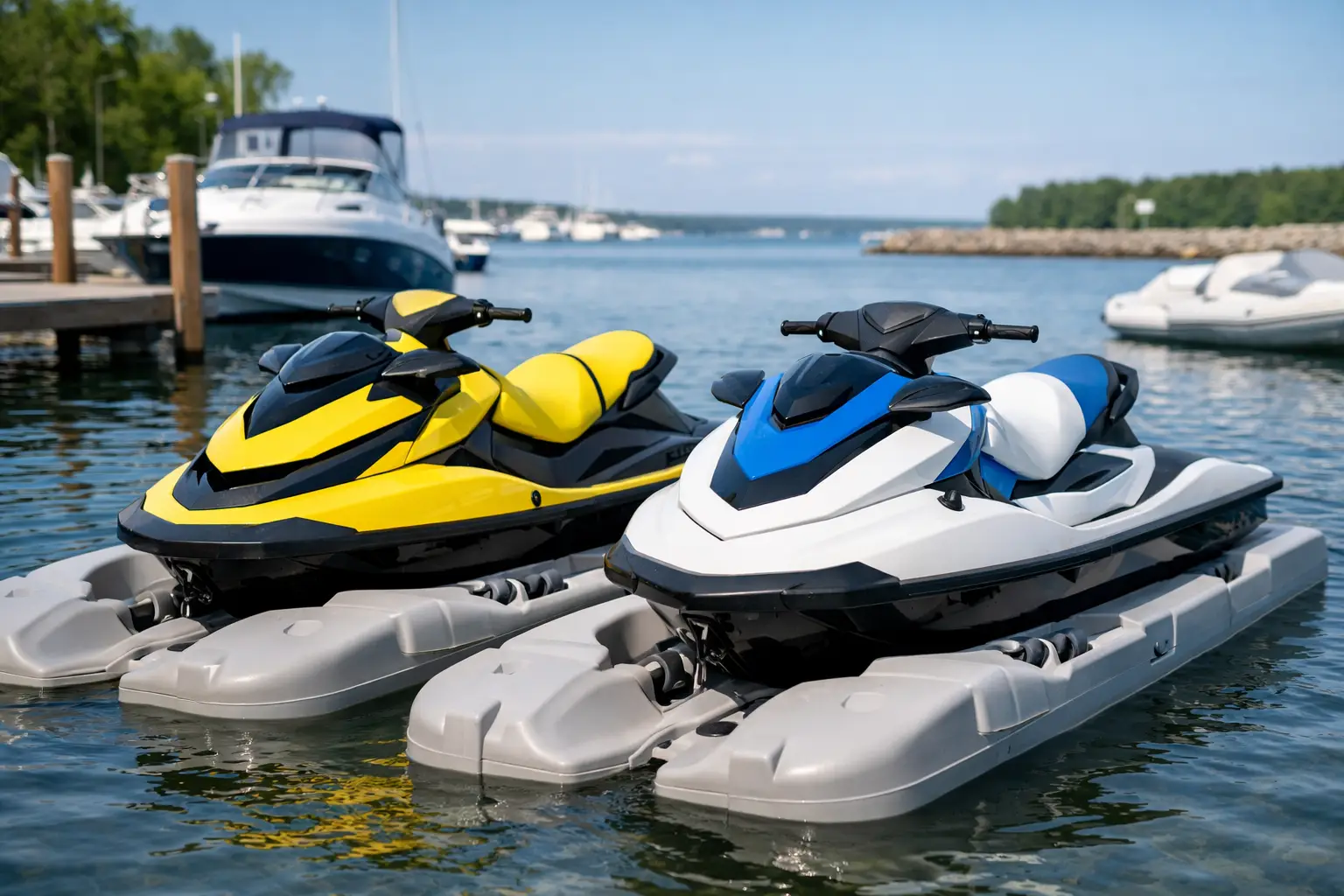
A personal watercraft left in the water can take a beating between rides. Constant hull exposure, wake impact, algae growth, changing water levels, and the inconvenience of tying up and covering the craft all add up. PWC ports give owners a better place to keep a jet ski, WaveRunner, Sea-Doo, or similar watercraft: elevated above the water, ready to launch, and connected to the dock system they already use.
For lake homes, marinas, resorts, and rental operations, a drive-on port is more than a convenience accessory. It helps protect a valuable asset while making waterfront use simpler for riders of different ages and experience levels. The right setup depends on the watercraft, shoreline conditions, traffic on the water, and how the dock is anchored.
What PWC Ports Do Differently
A PWC port is a floating drive-on platform designed to hold a personal watercraft out of the water. Rather than lifting the craft with a trailer or securing it alongside a dock, the rider drives onto a series of rollers or molded supports. The hull settles into position above the waterline, where it can drain and remain more protected between uses.
This approach addresses a common problem at busy waterfront properties. Personal watercraft are easy to use on a summer afternoon, but they can be awkward to store at the end of the day. A conventional tie-up leaves the hull in the water and puts it at risk from rubbing, wave action, and changing water conditions. A shore-based trailer may be practical at some properties, but it means launching and retrieving the craft every time someone wants to ride.
With a properly selected port, launching is straightforward. The rider pushes or drives the watercraft off the platform, then returns to the same location when finished. The port moves with a floating dock, so it is especially useful on reservoirs and lakes with seasonal water-level changes.
Why Keeping a PWC Out of the Water Matters
The most visible benefit is hull protection. Watercraft that remain in the water are exposed to algae, mineral staining, and other buildup that requires more frequent cleaning. In certain bodies of water, extended wet storage can also make owners more concerned about corrosion, especially around metal components and hardware.
There is also the matter of impact. Even a securely tied personal watercraft can shift against a dock when boat wakes roll through. Wake exposure is a significant consideration on active lakes, near marinas, and along public waterfronts. Raising the craft out of the water reduces the time it spends absorbing that motion.
For many owners, however, the biggest benefit is simply use. When the watercraft is already positioned at dock level, it is easier to take a quick ride before dinner, let guests use it under supervision, or prepare a rental fleet for the day. Equipment that is hard to launch tends to sit unused. A drive-on port removes one of the common barriers between owning a PWC and enjoying it.
Choosing the Right PWC Port for Your Watercraft
Personal watercraft ports are not one-size-fits-all. The port must support the craft’s weight, hull shape, and overall dimensions. It also needs to provide enough flotation and stability for the conditions at the site.
Start with the specific make and model of the watercraft, including its loaded weight. A port should not be selected based only on a broad category such as “jet ski.” Larger three-seat models, fishing-focused PWCs, and watercraft carrying added accessories may require a different configuration than a lighter recreational model.
Hull support matters as much as capacity. The rollers or bunks should guide the craft into place without creating unnecessary pressure points. A well-matched system makes loading predictable and helps the rider center the watercraft each time. If riders must repeatedly muscle the craft sideways, struggle to get over the first roller, or guess where to stop, the port layout needs attention.
The water itself is another deciding factor. A protected private cove creates different demands than an open reservoir exposed to regular boat traffic. In shallow water, the approach must remain clear enough for the craft’s draft. In deeper water, anchoring and gangway design become more important. Properties with fluctuating water levels often benefit from a fully floating system that rises and falls with the lake.
PWC Port Placement Is a Safety Decision
A port should make arrivals and departures easier, not create a pinch point in the dock layout. Placement affects rider visibility, pedestrian traffic, boarding access, and the way wakes move through the system.
At a residence, a PWC port is often positioned along the outside edge of a floating dock or near a designated recreation area. This can keep the launch path clear of boat slips and fishing space. At a marina or resort, grouping multiple ports may be more efficient, but enough room is needed for riders to approach, turn, and exit without crossing through congested boat lanes.
Consider where people will walk. Family members, guests, and customers should not have to step over PWC handlebars, tow ropes, or fueling equipment to reach the shore connection. A thoughtful layout provides a stable walkway beside the port and leaves room for boarding, cleaning, and securing the craft.
It is also wise to think about wind direction and prevailing wake. A port located at the most exposed corner of a dock may still work, but it may require a more substantial anchoring plan or a different orientation. The goal is to limit unnecessary dock movement while keeping the approach intuitive for the rider.
Matching the Port to a Floating Dock System
A PWC port performs best as part of an integrated waterfront system. The dock, connection hardware, anchoring, shoreline access, and port all influence one another. Adding a port to an undersized or poorly stabilized dock can create problems that the port itself cannot solve.
Modular floating docks offer a practical advantage because the layout can evolve. A homeowner may begin with one watercraft port and later add a boat slip, kayak launch, swim platform, or additional walking surface. A commercial operator may reconfigure the layout as fleet size, customer traffic, or programming changes.
The connection between the port and dock deserves professional attention. It must accommodate the movement of the floating system while providing a secure transition for users. The dock should also have enough usable space around the port for normal traffic. This is particularly important for public facilities, where accessibility, supervision, and predictable circulation are part of the project requirements.
EZ Dock Texas helps property owners and facility managers evaluate the complete system rather than treating the port as an isolated purchase. That includes considering water depth, exposure, water-level variation, intended users, and the long-term purpose of the waterfront.
Questions to Answer Before Installation
Before finalizing a PWC port design, property owners should be able to answer a few practical questions:
- What are the model, weight, and hull style of each personal watercraft?
- Will the port be used in protected water, open water, or an area with regular wake exposure?
- How much does the water level change during the year?
- Does the existing dock have adequate flotation, stability, and walkway space?
- Who will use the port, and will they be comfortable driving on and off it?
- Is future expansion likely, such as another PWC, a boat port, or a kayak launch?
These answers help prevent a common mistake: buying a port that fits the watercraft but not the property. A well-designed system considers both. For example, a ranch pond may need a compact, straightforward configuration, while a resort may need multiple ports arranged for operational efficiency and guest safety.
Maintenance and Everyday Use
One reason owners choose floating PWC ports is that they reduce routine upkeep compared with wet storage. Still, the port should be inspected regularly. Check connection hardware, rollers or supports, and the surrounding dock surface for debris. Keep the launch path clear, especially after storms, high water, or heavy shoreline runoff.
Riders should approach at a controlled speed and follow the port manufacturer’s loading guidance. Momentum helps the craft travel onto the rollers, but excessive speed can create a hard impact or overshoot the intended resting position. New riders usually benefit from a brief demonstration before using the system independently.
For commercial properties, consistent operating procedures matter. Staff should know how to inspect ports, assist customers when needed, and identify conditions that call for temporary closure, such as storm debris, unusual water levels, or damaged dock hardware.
A PWC port should make waterfront ownership feel easier, not add another piece of equipment to manage. When it is sized correctly, placed thoughtfully, and integrated with a stable floating dock, it gives your watercraft a protected home and gives every ride a simpler starting point.