A personal watercraft parked in the water all season can collect algae, take on storm debris, and require more cleaning than most owners expect. That is why the choice between drive-on ports versus lifts matters before a dock layout is finalized. Both keep a boat or PWC out of the water when it is not in use, but they do it differently – and the better fit depends on the vessel, shoreline conditions, water-level changes, and how people actually use the waterfront.
For many lake homes, marinas, parks, and rental operations, the right answer is not simply the system with the lowest initial cost. It is the option that provides reliable access, protects the equipment, and works with the dock for years to come.
Drive-On Ports Versus Lifts: The Fundamental Difference
A drive-on port is a floating platform designed to let a personal watercraft, and in some cases a small boat, be driven onto a supported surface above the waterline. Rollers, bunks, or other guides help center the vessel as it moves into position. To launch, the operator simply backs off the port and into the water.
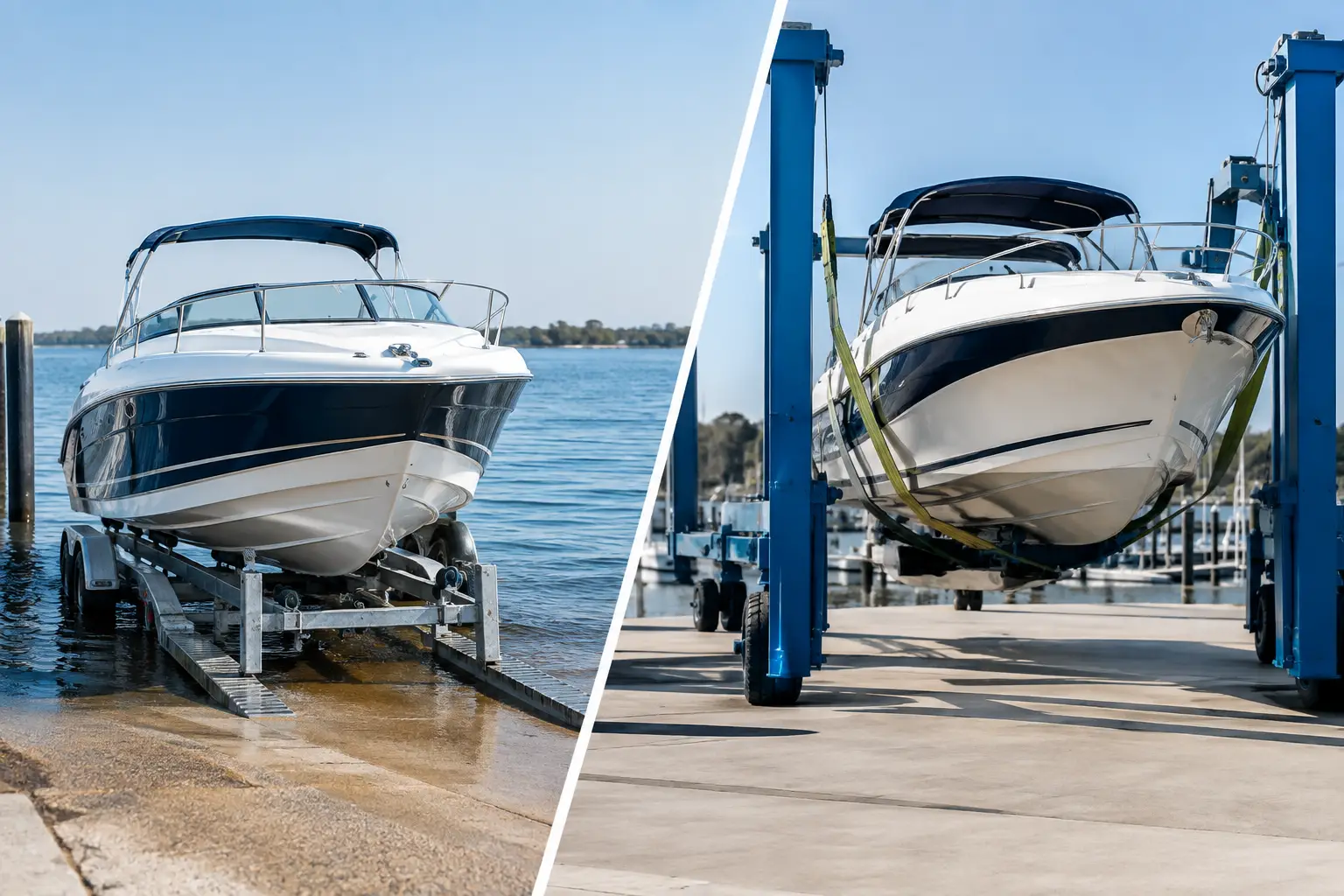
A lift uses a mechanical system to raise and lower a vessel. Traditional boat lifts may be mounted to pilings, a fixed dock, or a floating dock structure, depending on the product and site. The boat is positioned over the lift, then elevated using a manual, electric, hydraulic, or other powered mechanism.
Both approaches reduce hull growth and limit the time a vessel sits in the water. The practical distinction is straightforward: a drive-on port relies on flotation and a guided entry, while a lift relies on mechanical lifting components.
When a Drive-On Port Is the Better Choice
Drive-on ports are especially well suited to personal watercraft. A rider can return from a ride, line up with the port, apply controlled throttle, and secure the PWC out of the water in seconds. That simple routine encourages proper storage, particularly for families and rental operations where several people may use the equipment.
The convenience is also valuable for owners who do not want to operate a winch or wait for a lift to cycle. There are no cables to inspect before each use and no motor controls to manage. For a PWC used frequently throughout the day, that reduced effort can make a meaningful difference.
Because the port floats with the dock, it is often a practical match for reservoirs and lakes with changing water levels. This is a common consideration across Texas, Oklahoma, Arkansas, and New Mexico, where seasonal rain, drought, and reservoir management can noticeably change the shoreline. A properly configured floating dock and port move together, preserving the relationship between the boarding surface and the water.
Drive-on systems can also support a cleaner, more organized dock layout. A PWC has a designated parking location rather than occupying a boat slip, tying off alongside the dock, or sitting on a trailer along the shore. For homeowners, that can preserve space for swimming, fishing, or boarding a larger boat. For marinas and resorts, it can create a more consistent guest experience.
Where Drive-On Ports Have Limits
A drive-on port is not automatically the answer for every vessel. It must be sized and selected for the craft’s weight, hull shape, length, and intended use. A heavy PWC, a three-seat model loaded with gear, or a small boat may require a port with greater capacity and more specific support geometry.
Water depth and approach conditions matter as well. The rider needs enough water to approach and leave safely, and the port needs to remain usable at the expected water levels. Exposed, high-wake locations may require additional planning for anchoring, orientation, and protection.
There is also a learning curve. Most riders quickly become comfortable with a drive-on port, but they need to approach at a controlled speed and stay centered. At a busy public facility, clear procedures and a layout that separates launching from through-traffic help keep the experience safe.
When a Lift Is the Better Choice
A lift is often the stronger choice for conventional boats, particularly when the vessel is too large, too heavy, or not shaped for a drive-on platform. Fishing boats, runabouts, pontoons, wake boats, and other larger craft commonly need the adjustable support and higher capacity that a properly specified lift can provide.
Owners may also prefer a lift when they want the vessel elevated well above routine water movement. In some applications, raising the boat provides more clearance from waves, wakes, floating debris, and changing water conditions than a floating port can offer. The lift can also make it easier to inspect the hull or perform limited cleaning while the vessel is supported.
For boat owners who keep the same vessel in the same slip for years, a lift can be a highly effective long-term protection tool. When matched to the boat and maintained correctly, it helps keep the hull drier and reduces the need for bottom cleaning associated with prolonged in-water storage.
What to Plan for With a Lift
The trade-off is mechanical complexity. Lifts have moving parts, cables, bunks, pulleys, motors, switches, and structural components that need periodic inspection and maintenance. The exact needs vary by lift type, use frequency, and environment, but a lift should never be treated as a set-it-and-forget-it accessory.
A lift also needs a stable, compatible support system. On a fixed dock, that can mean careful coordination with pilings and dock framing. On a floating dock, the engineering of the dock, flotation, connections, and anchoring must account for the vessel load and the lift system. A large boat cannot be added to a dock layout as an afterthought.
Power availability may affect the decision, too. Electric lifts are convenient, but they require appropriately installed power and controls. Manual options may avoid electrical work, though they are less convenient for frequent use. In public or commercial settings, access control and operating procedures become part of the planning process.
Compare the Daily Experience, Not Just the Equipment
The best way to choose is to picture an ordinary Saturday at the dock. If family members will take a PWC out several times, a drive-on port offers fast, intuitive launching and storage. If a larger boat leaves once in the morning and returns in the evening, operating a lift may be a perfectly reasonable part of the routine.
Consider who will use the system. A drive-on PWC port can be easier for experienced riders, but younger or newer operators should be taught the correct approach. A boat lift may require less throttle precision at docking, yet it introduces controls and lifting procedures that users must understand.
Frequency matters. Equipment used constantly benefits from a simple workflow. Equipment used occasionally may justify a more involved process if that process offers better support, capacity, or protection for the vessel.
Dock Layout and Site Conditions Should Lead the Decision
The port or lift is only one part of the waterfront system. Gangway slope, water depth, shoreline access, dock orientation, anchoring, wind exposure, wake conditions, and available slip space all influence the final design.
For example, a floating PWC port can be placed alongside a main walkway, at the end of a finger dock, or in a dedicated recreation area. Its placement should allow a safe approach and leave adequate room for people walking, fishing, or loading gear. A lift must be located where the vessel can enter and exit cleanly without creating conflicts with neighboring slips or dock traffic.
Commercial and public facilities need another level of planning. A campground may need multiple easy-to-use PWC ports for guests. A marina may need a mix of lifts for slip holders, drive-on ports for rental equipment, and accessible dock routes that keep circulation clear. Municipal and park projects may also need to consider durability, supervision, procurement requirements, and the ability to adapt the system as use changes.
A modular floating dock system can be especially useful when needs evolve. A port can be added, relocated, or reconfigured as recreation patterns change. That flexibility is valuable, but it still requires proper load planning and anchoring from the start.
Questions Worth Answering Before You Buy
Before selecting either option, identify the vessel’s exact model, dry weight, dimensions, and typical gear load. Then evaluate the range of water levels, minimum depth at the proposed location, normal wind and wake exposure, and the way users will approach the dock.
It also helps to think beyond the current boat or PWC. If a family plans to upgrade to a larger craft, add another personal watercraft, or turn a private lakefront into a more active gathering space, the dock should have room to grow. The lowest-cost option can become expensive if it forces a major reconfiguration a year later.
For complex sites, a design consultation is more valuable than a product-only conversation. An experienced waterfront partner can look at the whole system – dock configuration, access, anchoring, vessel storage, and long-term use – rather than treating the port or lift as an isolated purchase.
The practical choice comes down to how you use the water. A drive-on port is often the easy, low-maintenance answer for frequent PWC use, while a lift is often the better fit for larger boats and applications requiring elevated support. Start with the vessel and the site, then build a dock plan that makes every return to shore safer, simpler, and ready for the next outing.