A temporary dock can look straightforward once it is floating, but its security depends on work that happens before the first section reaches the water. Whether you are setting up access for a waterfront event, a rowing program, a marina overflow area, emergency response, or a short-term rental operation, knowing how to secure temporary docks protects people, vessels, and the shoreline.
The right approach is not simply tying a floating dock to the bank. A secure temporary system must accommodate changing water, wind, wave action, soil conditions, intended traffic, and the length of time it will remain in service. The goal is controlled movement: the dock should rise and fall with the water while staying in its planned position without excessive sway, drift, or stress at connection points.
Start With the Site, Not the Dock
Every temporary dock plan begins with a site assessment. Water depth, bottom conditions, shoreline slope, prevailing wind, boat traffic, and water-level variation all affect the anchoring method. A protected pond used for a weekend fishing event has different requirements than an exposed reservoir cove serving a large public gathering.
Measure depth at the expected dock location and along the access path, not just at the shoreline. A system that floats well at launch may become difficult to access when water drops, or it may ground out where the bottom rises. In Texas and nearby states, reservoir levels can change substantially, so plan around anticipated operating conditions rather than a single water reading.
Also consider exposure. Open water allows wind to build waves that push a dock sideways and pull repeatedly against its anchors. Boat wakes can have a similar effect, especially near busy marinas, public ramps, or event venues. If the area is exposed, a longer dock, heavier anchoring, additional restraint points, or a more protected location may be necessary.
Choose an Anchoring Method That Fits the Conditions
Temporary does not mean lightly secured. The most appropriate method depends on the site, dock layout, duration of use, and whether the system needs to be removed quickly. In many cases, a professional design uses more than one form of restraint to keep the dock aligned while allowing normal vertical movement.
Shore Connections for Stable Access
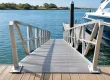
A properly designed gangway or shore ramp is often the first connection point. It provides the transition from land to the floating dock and helps guide the system, but it should not be expected to carry all lateral loads. The shore end must be attached to a stable landing area or structural connection that will not shift under foot traffic or dock movement.
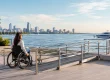
Gangway slope matters as much as anchoring. If water levels are expected to move, choose a length that maintains safe access through that range. A ramp that is comfortable at normal pool can become too steep during low water, creating an accessibility and safety concern for guests, staff, carts, or mobility devices.
Pile Guides for Predictable Vertical Movement
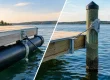
Pile-guided systems are a strong choice where piles can be installed and the dock needs to stay in a fixed horizontal location. The dock rides up and down along the piles as water changes, which limits side-to-side movement. This approach is often well suited to marina slips, public-access areas, and temporary facilities expected to remain in place for an extended season.
Pile installation requires an understanding of the lakebed and local approval requirements. The piles must be sized and embedded for the expected loads, not selected by appearance alone. Soft sediment, deep water, and wave exposure can all change the pile design.
Deadweight Anchors for Open Water or Short-Term Deployment
Deadweight anchors use concrete blocks or other engineered weights placed on the bottom and connected to the dock with chain or cable. They can work well when driving piles is impractical or when a system needs to be installed and removed without permanent alterations to the shoreline.
Anchor lines need enough scope to allow the dock to rise and fall, but not so much that it can wander out of position. This is where temporary installations are often underplanned. A line that appears tight at one water level can become overloaded as the water rises, while an overly long line can allow excessive movement during wind or wakes. Chain is commonly useful near the anchor because its weight helps maintain a consistent pull angle, but the complete connection must be selected for the site and load.
Stiff Arms and Shore-Based Restraints
Stiff arms connect a floating dock to fixed shore-side points and help control lateral movement. They are especially useful in protected water where the dock must remain aligned with a gangway or shoreline facility. Depending on the design, stiff arms may be combined with deadweights or piles for added control.
This method requires solid attachment points and sufficient clearance for the dock’s full vertical range. If a stiff arm reaches its travel limit at high or low water, it can transfer damaging loads into the dock or shore structure.
Build a Layout That Does Not Fight the Water
Dock geometry has a direct effect on stability. A long, narrow straight run is more likely to move at the outer end than a compact layout with properly placed anchors. Adding a perpendicular section, finger dock, or wider platform can improve function, but it also increases surface area exposed to wind and the leverage applied to connection points.
For temporary event docks, keep traffic patterns simple. Provide a clear route from shore to boarding areas, fishing access, kayak launches, or vessel slips. Avoid layouts that force people to cross active loading zones or step over mooring lines. If the dock will support a queue, a check-in point, or equipment staging, account for those concentrated loads during planning.
Modular floating dock systems are particularly useful because the layout can be configured around the shoreline and purpose of the installation. However, modular sections still need properly secured couplers and a complete anchoring plan. The dock sections are one system, not a collection of independent platforms.
Secure the Dock for Its Actual Use
The anchoring design must reflect what will happen on the dock. Foot traffic, utility carts, kayaks, personal watercraft, and boats all introduce different forces. A dock used only for anglers may need a different layout and load plan than one receiving groups of passengers from tour boats.
Boat mooring deserves special attention. Do not use a temporary dock as an improvised heavy-vessel tie-off unless the system, cleats, anchoring, and connection hardware are designed for that load. Wind and wakes can turn a moored boat into a powerful lever. Use appropriate cleats, lines, fenders, and slip configuration, and consider separate mooring piles where vessels will remain tied up for long periods.
For public use, add practical safety features early rather than after opening day. Handrails, lighting, ladder access, high-visibility edges, non-slip surfaces, and clearly defined entry points help reduce avoidable incidents. Accessibility requirements may apply to public facilities and should be evaluated during design, especially when the dock is serving a park, municipality, school, or event venue.
Inspect Before Opening and Throughout Use
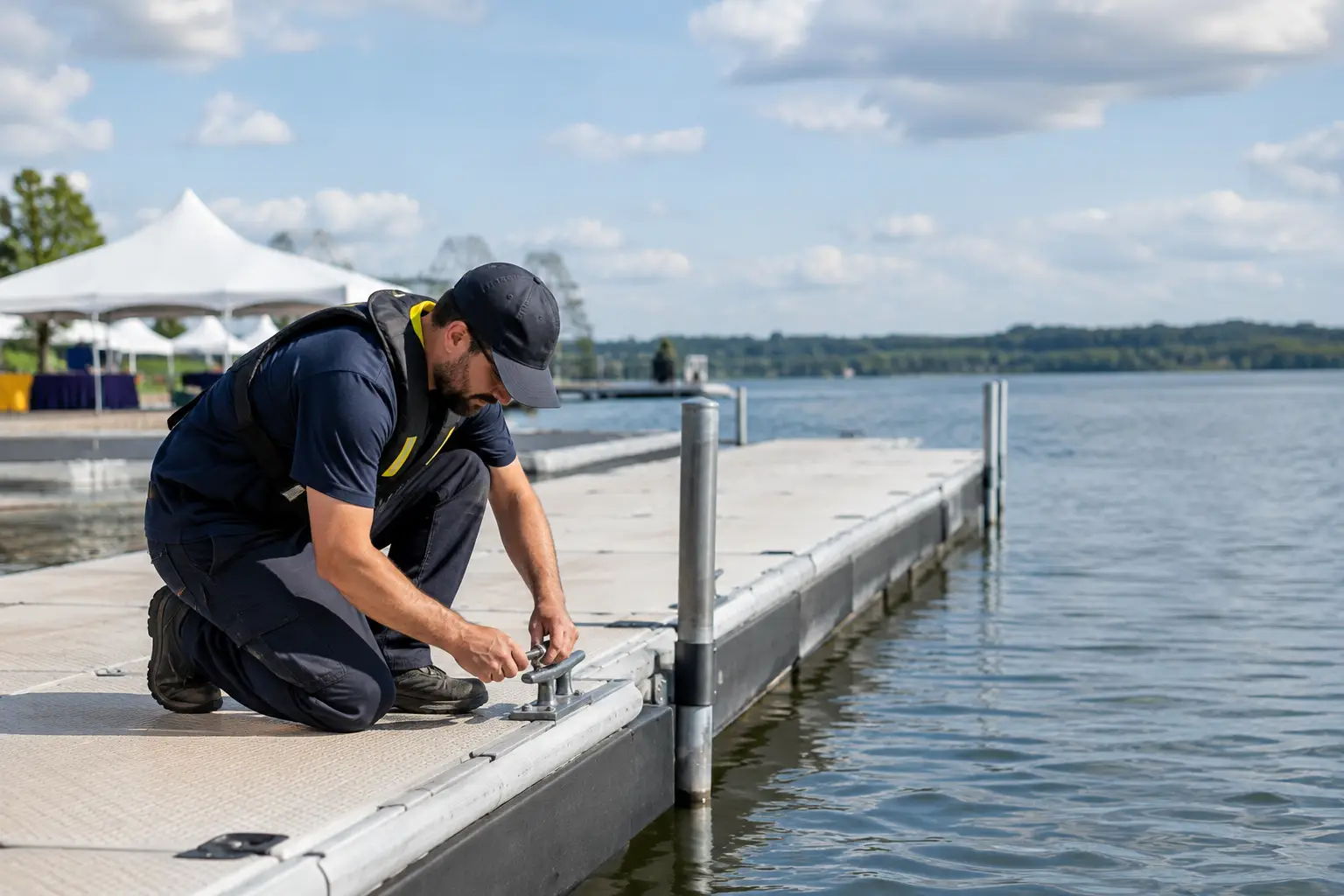
Temporary docks need routine checks because conditions change quickly. Before public use, inspect every coupler, anchor line, shackle, cleat, gangway connection, and shore attachment. Look for loose hardware, chafed lines, damaged flotation, shifting anchors, or sections that are no longer level.
During operation, inspect after heavy rain, high wind, large wakes, or unusual changes in water level. Designate one person to make the decision to restrict access or close the dock if conditions become unsafe. This is especially important for temporary events, where volunteers or rotating staff may assume someone else has checked the system.
A practical pre-opening review should confirm these five items:
- The dock is within its planned operating water-depth range.
- Anchors and shore connections are holding the dock in position.
- Gangways and walking surfaces are stable, clear, and safely sloped.
- Hardware, railings, ladders, and cleats are secure and undamaged.
- Weather and water conditions remain suitable for the intended activity.
Plan for Permits, Utilities, and Removal
Even a short-term dock may require permission from the property owner, lake authority, marina operator, municipality, or permitting agency. Requirements vary by waterbody and jurisdiction, particularly for public events, commercial operations, electrical service, and shoreline alterations. Address approvals early, because an otherwise well-designed dock cannot be used if it conflicts with local rules.
If power or lighting is part of the project, use marine-rated equipment and qualified electrical installation practices. Electrical hazards near water are serious. Keep cords protected, connections dry, and equipment appropriate for outdoor waterfront conditions.
Finally, have a removal plan before installation begins. Identify how sections, anchors, gangways, and accessories will be retrieved; where they will be staged; and what equipment is needed. A temporary dock should leave the site in good condition, without abandoned anchor lines, disturbed shoreline areas, or hardware that creates a hazard for boaters.
A well-secured temporary dock gives guests a stable place to gather, launch, board, fish, or work without pretending the water is predictable. For complex or public-facing projects, EZ Dock Texas can help match the dock layout and anchoring approach to the site, the season, and the people who will rely on it.