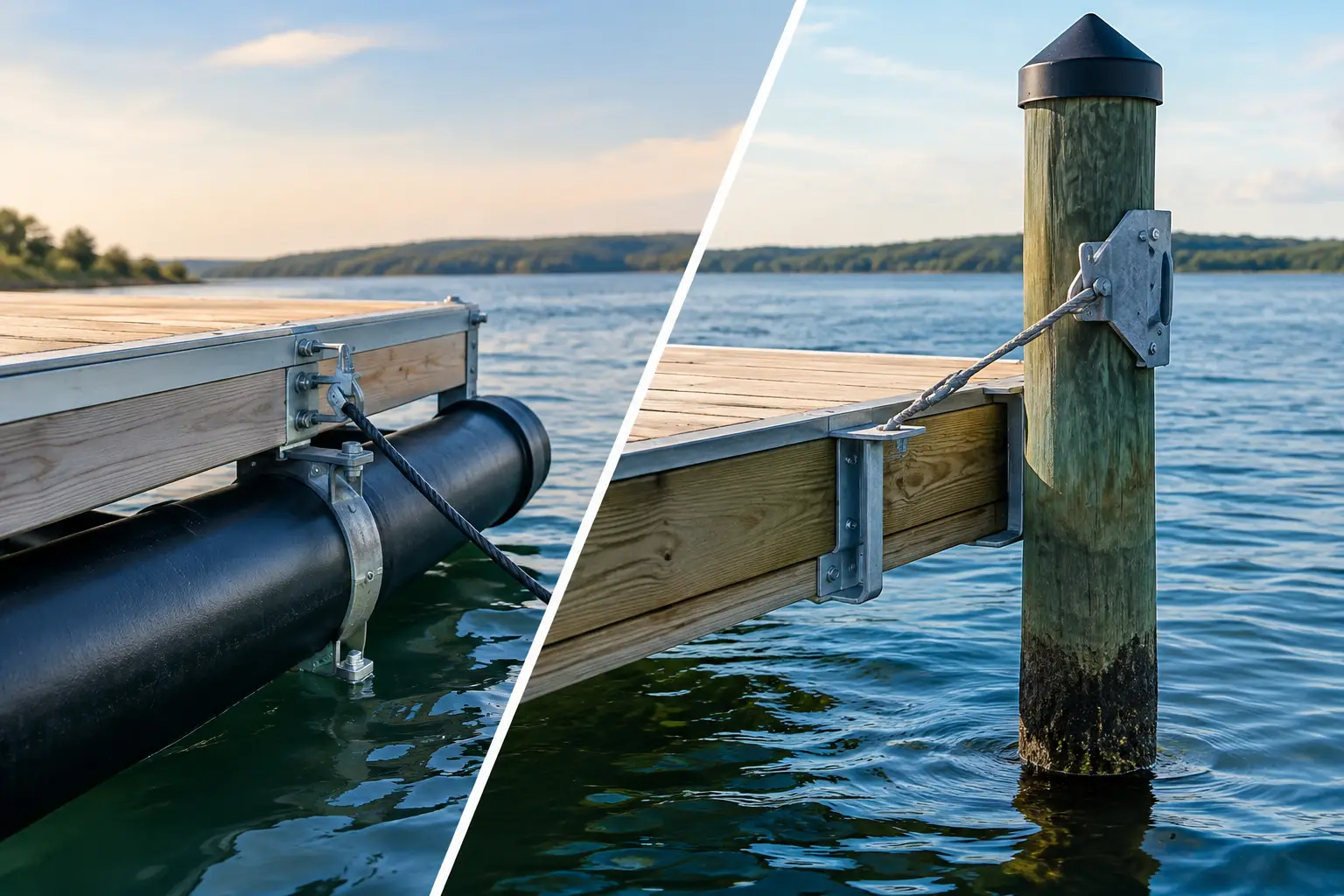
A floating dock is only as dependable as the system holding it in place. When comparing pipe anchors versus pile anchors, the right answer is rarely based on price alone. Water depth, bottom conditions, seasonal fluctuations, boat traffic, wind exposure, dock size, and permitting requirements all affect how a dock will perform year after year.
For a small private dock on a protected pond, a straightforward pipe system may be an efficient fit. For a marina, public-access pier, or long dock exposed to open-water waves, driven piles may provide the stability the project requires. The goal is not to choose the heaviest anchoring method by default. It is to select an anchoring approach that lets the dock move with changing water levels while resisting the forces trying to push it sideways, lift it, or pull it out of position.
How Floating Dock Anchoring Works
Unlike a fixed pier, a floating dock rises and falls with the water. Its anchoring system controls horizontal movement while allowing that vertical travel. Without proper anchoring, a dock can drift, twist under load, rub against shore connections, or become difficult to board safely.
Anchoring must account for more than calm-day conditions. A well-planned system considers prevailing wind, wave action, wake from boats, changing reservoir levels, ice where applicable, shoreline exposure, and the intended use of the dock. A platform supporting a kayak launch experiences different forces than a long commercial walkway with multiple boat slips.
The two common vertical-guidance options are pipe anchors and pile anchors. Both can work well with modular floating dock systems, but they are designed for different site conditions and load demands.
Pipe Anchors Versus Pile Anchors: The Core Difference
Pipe anchors use long, heavy-duty pipes installed through brackets or sleeves attached to the dock. The pipes extend down to the lake or pond bottom and upward enough to accommodate expected water-level changes. As the dock rises and falls, it slides along the pipe while remaining positioned laterally.
Pile anchors use larger structural piles, commonly steel or timber depending on the project, that are driven deeply into the bottom. Pile guides attached to the dock allow the floating structure to travel vertically along those fixed piles. Because piles have greater diameter, embedment, and load capacity, they are often used where conditions are deeper, rougher, or more demanding.
The terminology can occasionally cause confusion. Some projects use steel pipe piles, which are structural piles driven with specialized equipment, not the lighter pipe-anchor systems typically used for smaller docks. The important question is not the label alone. It is how the anchoring member is sized, installed, and engineered for the site.
When Pipe Anchors Are a Good Fit
Pipe anchoring is often a practical choice for residential docks, private ponds, protected coves, and smaller waterfront systems where water depths are manageable and the bottom can securely support the pipes. They are commonly selected for their straightforward design, clean appearance, and ability to accommodate normal seasonal water movement.
A pipe system tends to work best when the dock is relatively close to shore, the fetch is limited, and the bottom material is firm enough to hold the pipe in position. Clay, compacted soil, or stable sand may be suitable, while very soft muck, loose silt, or rocky bottoms can make installation more complicated.
Pipe anchors can also be appealing when access for large installation equipment is limited. They may be easier to install than driven piles in certain residential settings, although the installation still needs to be handled carefully. The pipe diameter, wall thickness, length, bracketing, and depth of penetration must match the dock’s expected loads.
Their limitations become clearer in deep water or high-energy locations. A very long pipe can flex under lateral pressure, particularly when exposed to repeated wave action or heavy boat wakes. If water levels rise beyond the usable length of the pipe, the dock can no longer travel safely. For that reason, pipe anchoring should be selected with the full anticipated water-level range in mind, not just the level present on installation day.
When Pile Anchors Make More Sense
Pile anchors are typically the stronger option for larger docks and more exposed waterfronts. They are frequently used for marinas, community docks, public facilities, long gangway connections, commercial operations, and locations with consistent wind or wake exposure.
Driven piles provide a more substantial vertical guide and better resistance to lateral movement. That added stability is valuable when the dock has multiple slips, carries higher pedestrian traffic, supports accessibility features, or serves boats that can place significant load on the system during boarding and mooring.
Piles also offer advantages in deeper water. A properly designed pile system can accommodate a greater vertical travel range than a typical pipe-anchor arrangement, making it a strong consideration for Texas reservoirs and other waterways with meaningful seasonal or operational fluctuations. The pile height must still be planned carefully so it accommodates high-water conditions without creating unnecessary visual impact or operational concerns at normal pool.
The trade-off is installation complexity and cost. Driving piles may require barge access, specialized equipment, experienced operators, and additional site planning. Some shorelines, protected waters, or public projects may also have more detailed permitting and environmental requirements. That investment can be worthwhile when it protects the long-term function and safety of a larger waterfront system.
Bottom Conditions Can Change the Decision
The lakebed or pond bottom deserves close attention before choosing either method. Firm bottoms generally offer better holding strength, while soft organic material can reduce anchoring performance. Rock can be equally challenging because it may prevent pipes or piles from reaching the planned depth.
A visual inspection from shore is not enough. Water depth can change quickly beyond the shoreline, and bottom conditions may vary across a single dock footprint. On a large project, site evaluation may include depth measurements, substrate assessment, and a review of how water levels have changed over time.
In some settings, a combination of anchoring methods may be appropriate. Shore-side connections can be handled differently from the outer end of a long dock, for example. Deadweight anchors, cable systems, or specialty solutions may also be considered where piles or pipes are not practical. The best design follows the site rather than forcing every property into the same solution.
Consider Dock Use, Not Just Dock Size
A compact fishing platform and a floating dock serving a busy campground may occupy similar water depths, yet require very different anchoring. The difference is how people, boats, and weather load the structure over time.
For residential use, think about the number and type of boats, whether personal watercraft ports or kayak launches will be attached, and whether the dock will host groups of family and guests. For commercial and public facilities, consider peak occupancy, maintenance access, emergency access, ADA-related design needs, and the impact of rental boats or frequent docking activity.
Wind exposure matters as much as traffic. A dock on an open shoreline can face far greater lateral forces than a larger dock protected inside a quiet cove. Fetch – the distance wind travels across open water before reaching the dock – helps determine the size of waves the system may experience. Heavy wakes can create similar stress, especially on popular recreational lakes.
Plan for Water-Level Movement and Permits
A floating dock should be designed around the realistic high and low water range, not an assumed average. Measure the dock’s expected vertical travel and compare it with the usable travel available on pipes or piles. Also account for a gangway that remains safe and functional as the dock moves. An anchoring system and access system must work together.
Before installation, verify local, lake authority, utility, and permitting requirements. Rules may address dock location, encroachment, pile placement, navigational clearance, environmental protection, or construction methods. Public agencies, HOAs, and commercial operators often have additional review steps. Early planning helps avoid redesigns after equipment and materials are already scheduled.
Choose the System That Supports Long-Term Use
Pipe anchors can be an excellent, economical solution for the right shallow or protected site. Pile anchors can provide the extra strength and travel range needed for deep water, high traffic, or exposed conditions. Neither is automatically better in every application.
The most reliable decision starts with a site-specific layout, realistic water-level data, and an honest assessment of how the dock will be used. EZ Dock Texas can help property owners, marina operators, and public agencies evaluate those factors and build an anchoring plan around the waterfront they actually have – not a one-size-fits-all assumption. A well-matched anchoring system protects the dock, improves day-to-day access, and gives everyone using the water more confidence.