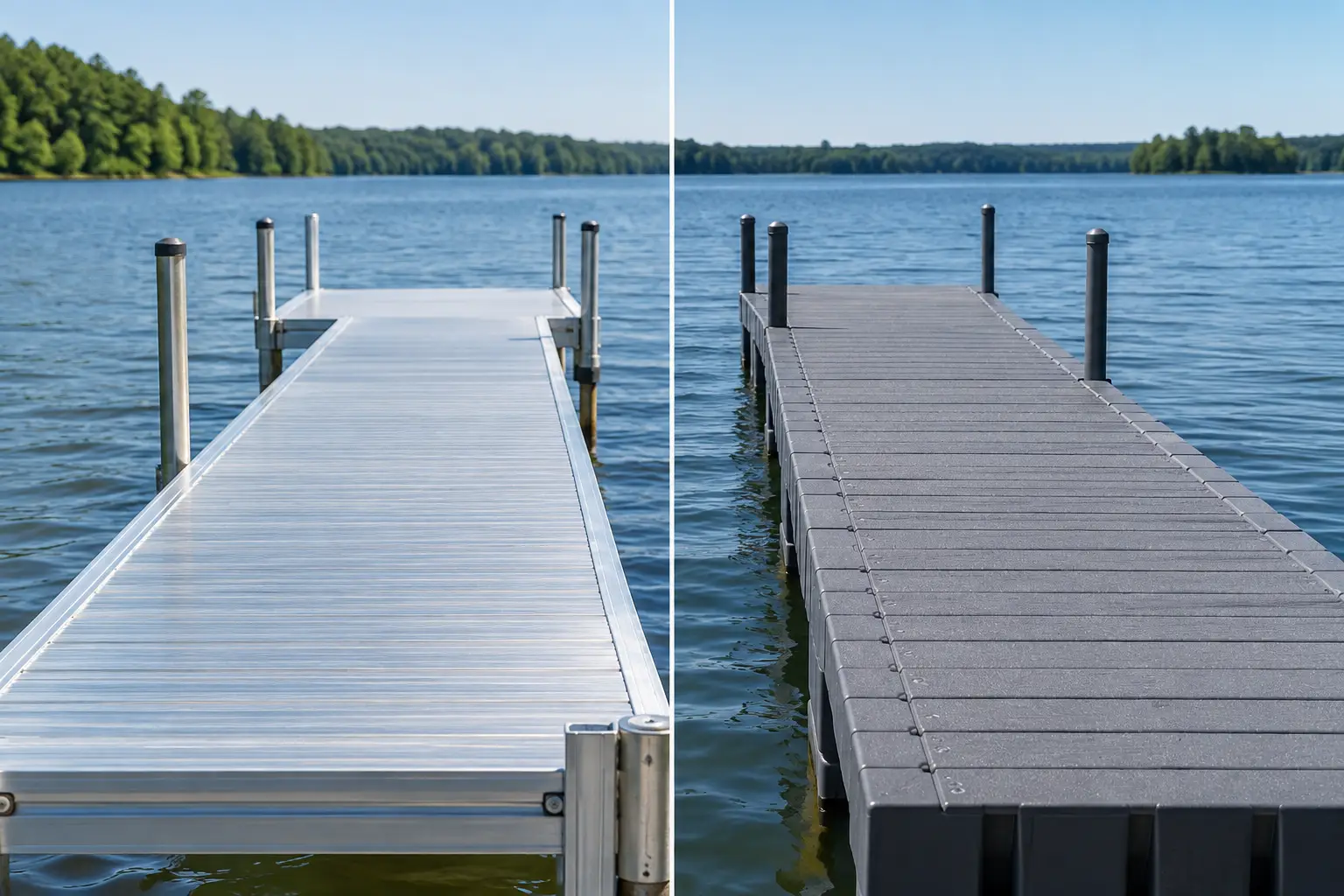
A dock can look like a simple platform from shore, but the material beneath your feet affects nearly every part of waterfront ownership: how it handles changing water, how much work it needs, how safely people move around it, and whether it can adapt when your needs change. The aluminum dock versus plastic dock decision is not about finding one universal winner. It is about matching the dock structure to your water conditions, intended use, budget, and long-term plans.
For lake homes, ranches, marinas, parks, and public-access projects, the right answer often starts with a more specific question: Do you need a fixed-looking walkway, a fully floating system, a high-capacity marina platform, a kayak launch, or a dock that can be reconfigured years from now?
First, Define What Plastic Dock Means
The term plastic dock can describe several products. In most floating-dock conversations, it refers to modular, rotationally molded polyethylene dock sections. These sections are typically hollow, buoyant, and designed to connect into larger layouts. Some dock buyers also use the term for docks with composite or plastic decking over an aluminum frame, but that is a different construction method with different performance characteristics.
An aluminum dock generally uses an aluminum frame with decking panels and flotation beneath it when configured as a floating dock. Aluminum systems may be built in sections, but their design often resembles a more conventional framed dock. Both can serve waterfront properties well. Their practical differences become clearer when conditions get demanding.
Aluminum Dock Versus Plastic Dock: Durability
Aluminum has a well-earned reputation for strength. A properly designed aluminum dock can support substantial loads and create long, rigid walkways or larger platform areas. That can be attractive for marinas, commercial boarding areas, or properties that want the visual feel of a traditional dock.
However, durability is more than the frame material. Aluminum docks rely on multiple components working together: framing, fasteners, flotation, decking, hinges, and anchoring. In freshwater, aluminum performs well when the dock is correctly specified and maintained. In corrosive settings, around incompatible metals, or where electrical current is present in the water, the system requires careful material selection and inspection. Hardware and connection points deserve particular attention over time.
Modular polyethylene floating docks are molded as one-piece sections without exposed fasteners across the walking surface. Quality polyethylene is engineered to resist impact, moisture, rot, insects, and many common waterfront chemicals. It will not splinter, and it does not require painting, staining, or sealing. This construction makes plastic modular docks especially appealing where constant wet conditions and frequent recreational use are the norm.
That does not mean plastic is indestructible. Heavy equipment, sharp impacts, improper anchoring, or a layout not designed for local wind and wave exposure can damage any dock system. The advantage of a modular design is that a damaged section can often be addressed without rebuilding the entire dock.
Water Levels Often Decide the Issue
Across Texas, Oklahoma, Arkansas, and New Mexico, water levels can change dramatically. Reservoir drawdowns, seasonal rain, shoreline contours, and wind exposure all affect how a dock performs. A floating dock rises and falls with the water, but its anchoring system must still keep it stable and usable throughout that movement.
Both aluminum floating docks and plastic modular docks can be anchored for fluctuating water. The key is designing the system around the site. Pipe brackets may work in shallow, relatively stable water. Cable systems, deadweight anchors, piling connections, and specialized deep-water stabilization approaches may be more appropriate where water is deeper or levels move significantly.
Modular plastic systems have a particular advantage when a property needs to evolve with the shoreline. Sections can be added, removed, widened, or rearranged. A homeowner may start with a simple swim platform, then add a personal watercraft port, boat port, fishing extension, or kayak launch later. A campground or park can adjust its layout as programming, traffic patterns, or accessibility needs change.
An aluminum dock can also be expanded, but flexibility depends on the original frame design and manufacturer. If future expansion is likely, ask about it before committing to a layout.
Daily Maintenance and Long-Term Ownership
For many owners, maintenance is where the aluminum dock versus plastic dock comparison becomes most meaningful. Aluminum itself does not rot, but aluminum docks may include decking that needs care. Wood boards can weather, splinter, fade, and require sealing. Composite decking reduces some upkeep but may retain heat and can add weight. Fasteners, hinges, and flotation should also be inspected regularly.
Plastic modular docks generally need routine cleaning, seasonal inspections, and attention to their anchoring and connections. A rinse or mild cleaning can remove dirt, algae, and surface residue. Because the walking surface and flotation are integrated, there are fewer separate components exposed to everyday wear.
For a busy marina, public park, rental operation, or lake home used by multiple generations, less maintenance can mean more than saving weekend work. It can reduce downtime, simplify facility planning, and help keep the waterfront area consistently presentable and safe.
Safety, Comfort, and Accessibility
A dock must work for the people using it, not just look good from the bank. Consider children, older family members, guests carrying coolers, anglers, paddlers, and staff members moving equipment. Surface traction, transitions, railings, ladders, lighting, and gangway slope all matter.
Aluminum-framed docks can provide a firm, familiar walking surface, but the decking choice strongly affects traction and barefoot comfort. Metal and darker decking materials can become hot under intense sun. Wood can become slick if neglected. The dock should be evaluated as a complete system rather than by frame material alone.
Many modular plastic docks have molded, textured surfaces designed for wet-foot traction. The material is typically comfortable for barefoot use and does not produce splinters. Its low freeboard can also make it easier to enter a kayak, canoe, or personal watercraft from the water. For public or institutional projects, a properly designed gangway and accessible route are just as important as the dock material. Accessibility requirements should be considered early, before the layout and anchor points are finalized.
Load Capacity and Intended Use
Aluminum may be the practical choice when a project requires a large, rigid platform or concentrated loads beyond what a standard modular section is designed to carry. That might include certain commercial service uses, specialized equipment, or a layout that needs long unsupported spans. The engineering details matter, so load expectations should be discussed at the design stage.
Plastic modular docks are highly capable for recreational boating, fishing, swimming, paddlesports, personal watercraft access, floating walkways, and many public-access applications. They work especially well when the project benefits from wide, stable platforms assembled from repeatable sections. Boat ports and PWC ports can keep watercraft out of the water while making launch and retrieval easier.
Avoid choosing based solely on the idea that one material is stronger. A dock that is oversized in the wrong areas or under-anchored for the site will not deliver good performance. Capacity, freeboard, flotation, gangway design, wind exposure, and anchoring must be considered together.
Upfront Cost Versus Lifetime Value
The purchase price of an aluminum or plastic dock is only one part of the investment. Include site access, shoreline conditions, delivery, installation, anchoring, gangways, accessories, future expansion, maintenance, and potential repairs in the comparison.
A basic aluminum dock can appear less expensive in some configurations, particularly when local conditions allow a straightforward installation. But recurring maintenance, decking replacement, and limited adaptability can change the long-term equation. A quality modular plastic dock may require a larger initial investment, yet its low-maintenance construction and ability to be reconfigured can create value over many years.
For commercial and public projects, downtime matters too. A system that can be repaired section by section or adjusted without replacing the entire dock can protect operating budgets and keep waterfront access available.
Choose the System Around Your Site
An aluminum dock may suit owners who want a traditional framed appearance, need specific structural capabilities, or have a layout designed around rigid deck sections. A plastic modular dock may be the better fit for changing water levels, low-maintenance ownership, watersports access, family use, and future expansion.
Before selecting either, assess the shoreline, typical and low-water depths, annual water-level changes, wave action, intended vessels, expected users, and local permitting requirements. A professional site evaluation can reveal issues that product brochures cannot, especially with deep water, steep banks, soft bottoms, or exposed locations.
The best dock is the one that remains safe, stable, and useful after the first season of ownership. EZ Dock Texas can help property owners and facility managers turn those site conditions into a customized floating dock plan built for the way their waterfront will actually be used.