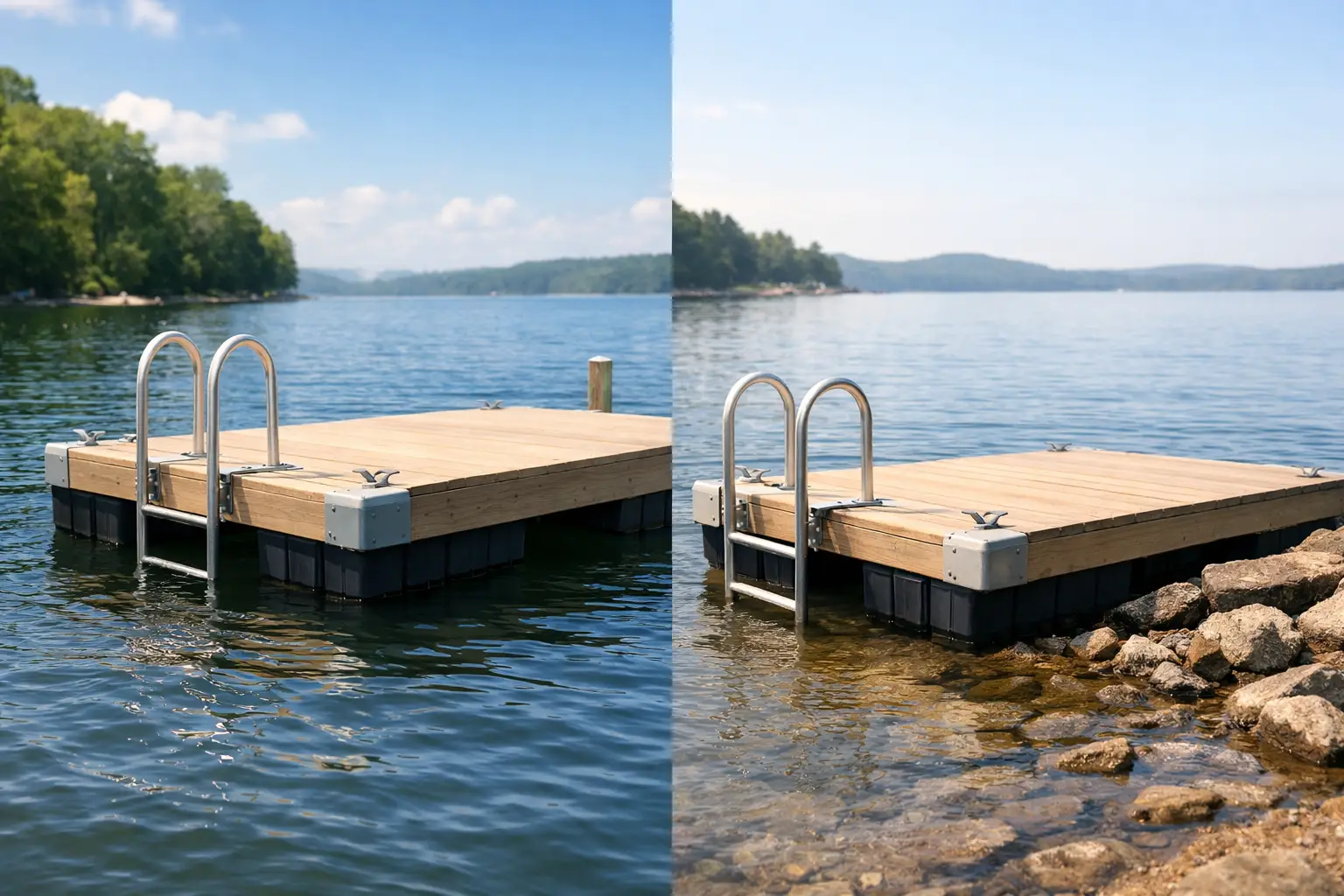
A shoreline can look completely different after a week of rain, a summer drought, or a reservoir release. Fixed docks stay where they were built, which can leave the deck too high above the water, underwater at the shoreline, or difficult to reach. Floating dock water level changes are different: the dock rises and falls with the water, keeping the deck-to-water distance far more consistent for boaters, anglers, swimmers, and paddlers.
That benefit does not happen by accident. A floating dock performs well through changing conditions only when its flotation, anchoring, shore connection, and layout are planned for the site. For lake homes, marinas, parks, ranches, and public waterfronts, the goal is more than a dock that floats. It is dependable access when the water does not stay still.
Why Floating Dock Water Level Changes Matter
Water-level movement affects every part of a waterfront experience. At high water, a fixed dock can lose usable freeboard or place the walkway close to the water. At low water, the same dock may sit far above the surface, making it harder to board a boat, launch a kayak, or use a swim ladder. Shoreline slopes can also expose a gap between the bank and the dock.
A modular floating dock moves vertically with the water. Because the deck remains at a relatively steady height above the surface, getting into a boat or stepping onto a PWC port feels more predictable. This is especially valuable for children, older family members, guests, rental customers, and public users who may not be familiar with the property.
The advantages extend beyond comfort. A dock that can respond to normal fluctuations is less likely to become unusable during the seasons when owners want it most. At commercial and public sites, maintaining functional water access can also support operations, visitor safety, accessibility planning, and staff efficiency.
Still, floating is not the same as maintenance-free or universally suitable. Wind exposure, wave action, extreme drawdowns, varying bottom conditions, and shoreline geometry all influence the right design. The system needs to be engineered around the conditions it will actually face.
What Lets a Floating Dock Move Safely
A well-designed floating system combines buoyant dock sections with hardware that controls where and how the dock travels. The dock should have enough flotation to carry its intended people, gear, accessories, and vessel loads while retaining appropriate freeboard. It should also be connected in a way that permits vertical movement without allowing excessive drift, rotation, or lateral movement.
Flotation and deck height
Floating dock sections rely on sealed, durable flotation beneath a stable walking surface. As water rises, buoyancy lifts the dock. As water falls, the dock settles with it. The practical result is a stable deck height relative to the water rather than a fixed elevation relative to the shore.
Deck height matters because different uses have different needs. A fishing pier may prioritize easy water access and room for anglers. A boat slip needs a usable boarding height and adequate clearance around the vessel. Kayak and canoe launches often benefit from a low, intentional entry point that makes it easier to transfer from dock to boat. A design consultation should account for those activities from the beginning rather than treating accessories as an afterthought.
Anchoring and guide systems
Anchoring is what keeps a floating dock in position while allowing it to rise and fall. Depending on the property, this can include pilings, cable systems, deadweight anchors, shore-side connections, or combinations of these methods. There is no single anchor style that fits every shoreline.
Pilings can provide strong vertical guidance where site conditions and permitting allow. Cable or winch systems can suit certain reservoirs and fluctuating lake levels, especially where a dock needs more travel range. Deadweight anchoring may be appropriate in locations where pile driving is impractical, although it must be sized for wind, waves, current, and dock configuration.
The trade-off is straightforward: more freedom of movement can require more thoughtful control. An undersized or poorly matched anchoring system may allow the dock to shift, pull against connections, or sit in an inconvenient position as conditions change. The anchoring plan should be based on water-depth data, expected high and low water, bottom composition, exposure, and the size of the complete dock system.
Gangways protect the shore connection
The gangway is often the most visible sign of changing water. While the dock moves vertically, the shore landing generally does not. A properly selected gangway bridges that changing elevation and provides a stable route between land and dock.
Its length and slope are critical. A short gangway can become steep when water drops, which makes walking more difficult and can limit carts, coolers, mobility devices, or service equipment. A longer gangway usually produces a gentler slope over the same vertical change, but it requires enough shoreline room and a suitable landing area.
For public-facing facilities, accessibility requirements and local regulations may affect gangway width, surface, railings, transitions, and allowable slope. Even at a private residence, these features can make a meaningful difference for guests and multigenerational families.
Planning for High Water, Low Water, and Everything Between
The best floating dock projects begin with realistic site information. A dock designed around the water level on installation day may not work well six months later. Reservoirs and managed lakes can experience dramatic seasonal drawdowns. Private lakes and stock ponds may respond quickly to drought or heavy rainfall. Rivers and protected marinas bring their own water movement and current considerations.
Start by identifying the normal operating range, not just the record high and record low. Then consider how the waterfront is used when levels are at either end of that range. A boat port may need deeper water to remain useful. A gangway may need more length at low water. A dock configured for swimming may need ladders placed where they remain accessible as the shoreline changes.
It also helps to plan for a dock that can evolve. Modular systems make it possible to add a fishing platform, reconfigure a slip, extend a walkway, add a PWC port, or relocate an access point as needs change. That flexibility can provide better long-term value than rebuilding a fixed structure when the property, water level, or recreational use changes.
Common Design Mistakes to Avoid
The most costly problems tend to come from planning a floating dock as if it were a simple platform. The dock itself may be durable, but the surrounding conditions still determine how it performs.
One frequent mistake is choosing a gangway based only on the current water elevation. Another is treating anchoring as a generic add-on instead of a site-specific structural decision. Owners can also underestimate wind fetch, the distance wind travels across open water before reaching the dock. A protected cove and an exposed lakefront may need very different stabilization strategies, even if the dock layouts look similar.
Accessory placement deserves attention as well. Cleats, railings, ladders, lighting, dock boxes, boat ports, and kayak launches all affect traffic patterns and usable deck space. On a busy marina or public dock, a clear path is a safety feature. On a residential dock, thoughtful placement can keep fishing, swimming, and boarding activities from competing for the same narrow area.
Finally, do not overlook inspection. Periodically check connectors, anchor lines or cables, gangway hardware, flotation, and shore attachments, particularly after storms or major water-level shifts. Low-maintenance materials reduce the work required to own a dock, but every waterfront system benefits from routine attention.
Choosing a System for Your Waterfront
The right response to floating dock water level changes depends on the location and intended use. A small ranch pond with occasional recreation may need a simple access dock and shoreline-friendly anchoring. A lake home may need a larger modular layout with a boat port, swim access, and a gangway sized for seasonal drawdown. A municipal park or marina may need wider access routes, durable railings, multiple launch points, and a design that manages heavier daily traffic.
This is where working with an experienced waterfront partner matters. EZ Dock Texas evaluates the full picture – water movement, shoreline conditions, access needs, activities, future expansion, and installation requirements – before recommending a system. The result is a dock layout built for the property rather than a collection of parts forced to fit after the fact.
Water levels will change. A properly designed floating dock gives you a practical way to keep using the waterfront through those changes, with safer access and room to enjoy what brought you to the water in the first place.