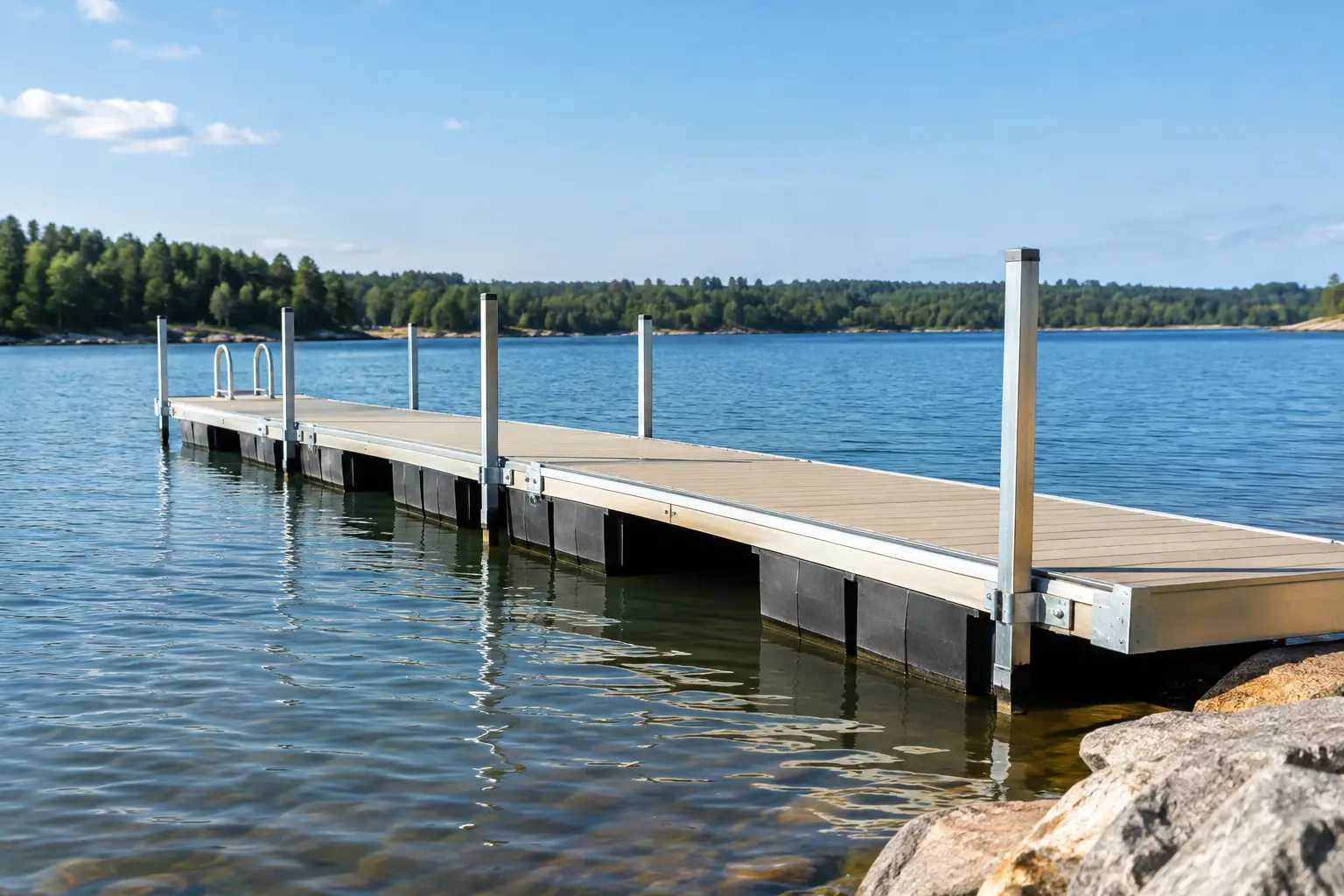
A floating pier should move with the water level, not wander across it. If you are researching how to stabilize floating pier systems, the goal is to control unwanted side-to-side, forward-and-back, and rotational movement without preventing the pier from rising and falling as the water changes.
That balance matters on everything from a private lake dock to a public fishing pier or marina walkway. A pier that shifts excessively can make boarding uncomfortable, strain connections, pull a gangway out of alignment, and create avoidable safety concerns. The right stabilization method depends on water depth, bottom conditions, wind exposure, water-level variation, vessel traffic, and how the pier will be used.
Start With the Source of the Movement
Before adding anchors or hardware, identify what is making the pier unstable. Wind can push a broad dock surface sideways, especially on open Texas reservoirs where long fetches allow waves to build. Boat wake can create repeated rocking, while current may pull a pier in one direction for extended periods. In shallow ponds and protected coves, the issue may simply be an undersized or poorly positioned anchor system.
Movement is not always a failure. A floating pier is designed to have some give. The concern is movement that affects safe access, allows sections to twist, causes repeated impact against shore or pilings, or puts excessive load on the gangway and dock connections.
Look at the movement while the pier is in normal use and again during higher wind or boat traffic. A system that feels steady on a calm morning may behave very differently when the water is busy. This assessment also helps distinguish a stabilization problem from a flotation or connection problem. If one dock section sits lower than the rest, has loose couplers, or flexes independently, repair those conditions before changing the anchor layout.
Choose a Floating Pier Stabilization Method That Fits the Site
There is no universal anchor arrangement. The best option is the one that manages the forces at your shoreline while accommodating the full expected water-level range.
Guide piles provide firm lateral control
Guide piles are often the preferred solution for floating piers in deeper water, high-traffic areas, and locations with considerable water-level change. The pier is fitted with pile guides that slide vertically along steel or composite piles. This lets the structure rise and fall while limiting sideways travel.
Piles can provide excellent long-term stability, but they require a proper site evaluation. Water depth, soil or lakebed conditions, pile penetration, seasonal drawdown, wave action, and permitting requirements all affect the design. A pile that looks adequate at normal pool may become too short when water rises, or it may not have enough embedment to resist lateral force.
For commercial, municipal, and public-access applications, guide piles are often worth the added planning because they create a predictable, orderly pier position. They are also useful where a gangway must remain aligned for accessibility and safe pedestrian travel.
Anchor systems work well where piles are impractical
Anchors hold a floating pier in position through chains, cables, or tension members extending to the lake bottom. They are commonly used where driving piles is not feasible, where water depths are substantial, or where a seasonal installation is preferred.
A properly engineered anchor system uses more than weight. Anchor placement and scope matter just as much. If anchor lines are too short or too steep, they can pull downward on the pier as water changes. If they are too long, the pier may swing farther than intended. The arrangement should resist force from multiple directions rather than merely holding the structure away from shore.
Common anchor approaches include:
- Concrete or steel deadweight anchors for firm, stable lake bottoms
- Helical or screw anchors where soil conditions support their use
- Driven or embedded anchoring components for specific bottom conditions
- Adjustable cable or chain systems designed for seasonal water movement
Anchors are not a one-size-fits-all purchase. Bottom composition varies dramatically between rocky reservoirs, soft sediment, clay shorelines, and private ponds. The right anchor weight, line type, and spacing should be selected for the actual site conditions and pier size.
Shore attachments control the landside connection
A stable floating pier needs a shore connection that can accommodate movement without becoming the point of failure. A gangway is often the best solution for a floating system because it bridges the changing elevation between land and dock. Its length, slope, landing area, and attachment details all affect usability.
Avoid treating the gangway as an anchor. It should provide access, not carry the load of preventing the pier from moving sideways. When a pier is held too tightly at shore, normal floating movement can stress the gangway, shoreline hardware, and dock frame.
In smaller, protected installations, a hinged shore ramp combined with correctly placed anchors may be sufficient. On larger systems, the shore connection should be considered part of the full stabilization plan, especially when wheelchair access, utility lines, or frequent cart traffic are involved.
Use the Layout to Reduce Stress Before It Starts
A long, narrow pier is more prone to twisting than a compact layout. A T-shaped or L-shaped configuration can increase usable space, but it also catches more wind and may need additional stabilization points. Likewise, adding boat slips, PWC ports, kayak launches, benches, railings, or lighting changes the overall load and wind profile.
The most stable layout usually distributes loads evenly and provides enough connection points to keep dock sections acting as one platform. Modular dock systems make it possible to expand over time, but every expansion should include a review of anchoring and stabilization. What worked for a small swim dock may not be adequate after adding a long walkway, two slips, and a covered seating area.
Positioning also matters. If possible, orient the pier to reduce exposure to prevailing wind and common boat wake. A protected cove may allow a simpler stabilization plan than an open shoreline. When exposure cannot be avoided, stronger anchoring, guide piles, wave attenuation, or a revised layout may be the more cost-effective answer over the life of the system.
Inspect Connections, Flotation, and Hardware Regularly
Even a well-designed floating pier needs periodic inspection. Check couplers, hinges, pile guides, chains, cables, shackles, and adjustment hardware for wear, corrosion, looseness, or distortion. Inspect after major storms, unusually high water, extended drawdowns, and any impact from boats or floating debris.
Pay close attention to chafe points where chains or cables contact the dock frame or edge protection. Hardware can look acceptable from above while wearing rapidly below the waterline. Worn components should be replaced with marine-appropriate parts sized for the system load.
Flotation deserves the same attention. Waterlogged, damaged, or poorly distributed flotation can cause a pier to list or sit unevenly. An uneven deck makes movement feel worse and can shift loads toward one side of the anchoring system. Modular, low-maintenance dock sections with integrated flotation help maintain a level walking surface, but damaged sections still need prompt attention.
Plan for High Water, Low Water, and Real Use
A stabilization system should be designed for conditions beyond the average water level. In Texas, Oklahoma, Arkansas, and New Mexico, reservoirs and private lakes may experience significant seasonal changes, drought drawdowns, storm-driven rises, and changing shoreline conditions. Build the plan around the realistic high and low range, not the water elevation on installation day.
Also consider how people will use the pier. A residential swim platform has different demands than a marina fueling dock, fishing pier, public launch, rowing facility, or temporary event dock. Public facilities may require accessible routes, handrails, edge protection, and more controlled movement. Rental and event applications often need installation methods that can be adjusted or removed efficiently.
Permitting and shoreline rules can shape the solution as well. Local lake authorities, utility districts, municipalities, and property covenants may regulate pier size, location, pile installation, and shoreline work. Addressing those requirements early prevents a design that works on paper but cannot be installed as planned.
Know When Professional Design Is the Better Investment
A few anchor adjustments may solve minor movement on a small, protected dock. But if a floating pier moves heavily, serves the public, supports boats, sits in deep water, or must handle major level changes, professional design is the safer path. The cost of correcting an undersized anchoring system after storm damage can quickly exceed the cost of planning it correctly at the start.
EZ Dock Texas helps property owners, marinas, parks, and public agencies evaluate the full picture: site conditions, intended use, access needs, dock configuration, anchoring, and long-term expansion. The result should not be a pier that feels rigid at all times. It should be a floating system that moves where it needs to move, stays where it needs to stay, and gives users confidence every time they step aboard.