A dark dock is more than an inconvenience after sunset. Uneven surfaces, changing water levels, wet footwear, cleats, ladders, and mooring lines can turn a short walk to the boat into a fall hazard. Dock lighting safety requirements should guide the layout from the beginning, especially when a dock serves children, guests, renters, marina customers, or the general public.
The right lighting makes the path, edge, connection points, and water access easier to see without producing harsh glare across the water. For floating dock systems, that calls for more than adding a few fixtures after installation. It requires a lighting plan that accounts for electrical safety, dock movement, local code, intended use, and the people who will use the waterfront after dark.
Dock Lighting Safety Requirements Start With the Use Case
There is no single lighting layout that fits every waterfront property. A private residential dock used by one family may need modest path and entry lighting. A busy marina, public fishing pier, campground, or municipal launch may need more consistent illumination, clearer wayfinding, emergency planning, and a formal review by the authority having jurisdiction.
Start by identifying when and how the dock is used. Evening boat access, fishing, kayak launches, overnight slips, fuel access, and public events each create different risks. A dock that is primarily used for sunset fishing needs safe footing and visible edges. A commercial dock where guests arrive after dark may also need clear route lighting from the shore connection to slips, ramps, and amenities.
The best plan lights the areas where a person must make decisions or changes in direction. That usually includes the gangway entrance, dock intersections, gate locations, transitions between shore and floating sections, steps, ladders, boarding areas, and dock ends. It does not necessarily mean flooding the entire waterfront with bright light.
Build Electrical Safety Into the Design
Water and electricity demand careful design and professional installation. Applicable electrical requirements can vary by location and project type, but installations commonly must comply with the National Electrical Code, local electrical codes, permit conditions, and utility or marina rules. Public and commercial properties may also face additional building, accessibility, fire, or agency requirements.
A qualified electrician should determine the correct wiring method, overcurrent protection, grounding and bonding approach, disconnects, and ground-fault circuit-interrupter protection for the installation. This is not an area for improvising with household extension cords, exposed splices, or fixtures not intended for wet environments.
Low-voltage LED lighting is often a practical choice for dock paths and perimeter lighting because it can reduce shock risk and energy use while providing dependable illumination. Low voltage is not a substitute for proper installation, however. Transformers, drivers, enclosures, connectors, and wiring still need to be selected for outdoor and wet-location exposure, installed according to manufacturer instructions, and protected from physical damage.
For floating docks, cable management matters as much as fixture selection. The dock moves with wind, wakes, and water-level changes. Wiring needs enough protection and flexibility to accommodate that movement without pinching, chafing, pulling loose, or becoming a trip hazard. Shore-to-dock connections require particular attention. A clean-looking installation that does not allow for movement can become a maintenance problem quickly.
Use Fixtures Rated for Wet, Marine Conditions
Not every outdoor light belongs on a dock. Dock fixtures should be listed and labeled for the environment where they will be installed, including wet locations when exposed to rain, spray, and splash. Materials should also stand up to ultraviolet exposure, heat, humidity, and the corrosive conditions found around many lakes and coastal environments.
Sealed LED fixtures are popular because they require less routine bulb replacement and typically draw less power than older lighting technologies. Still, evaluate more than the advertised brightness. Look at lens durability, mounting method, replacement parts, expected service life, warranty coverage, and whether the fixture can withstand contact from dock lines, gear, and foot traffic.
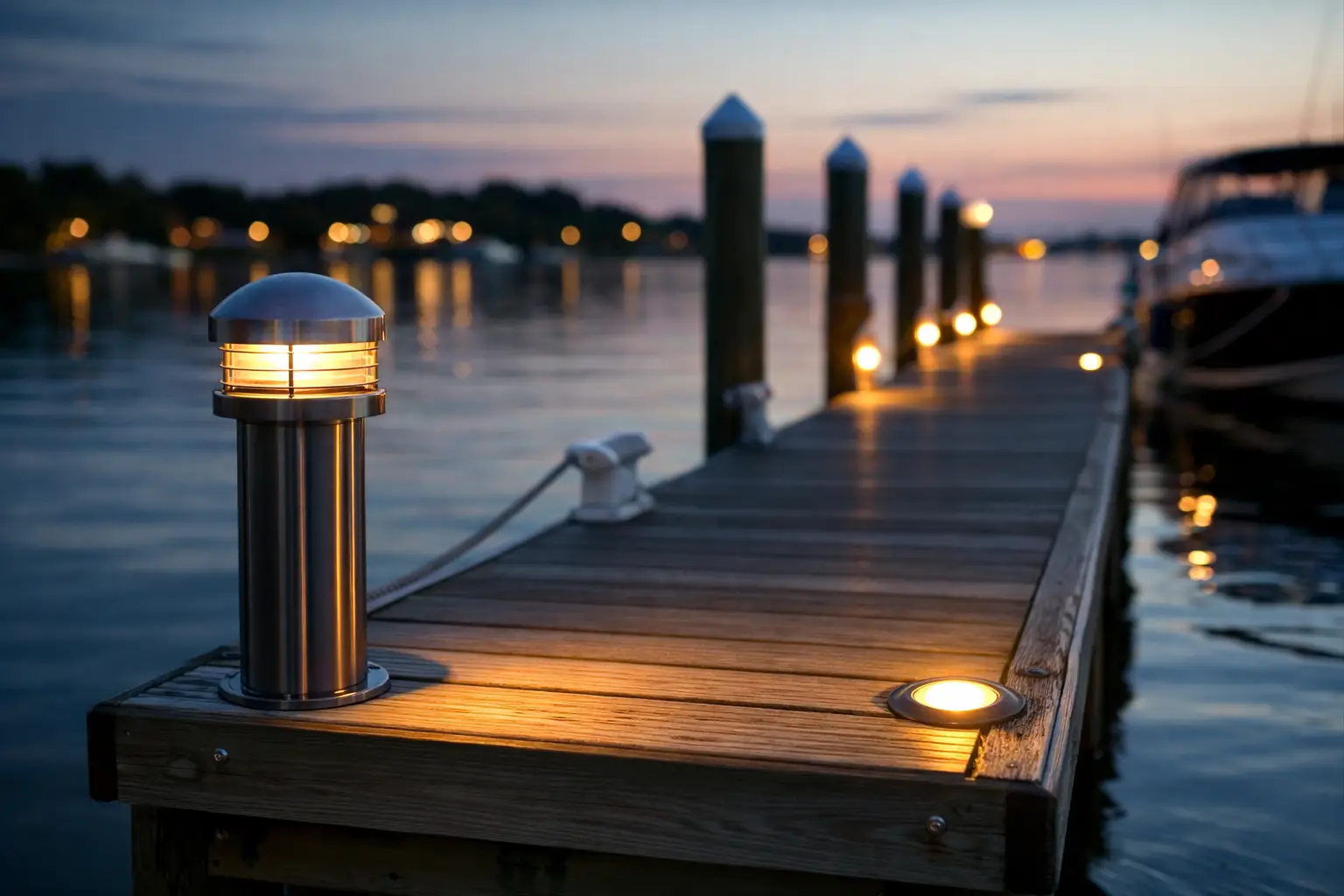
Flush-mounted lights can reduce snag points along a walking surface, but they must be installed where they will not create an unexpected change in footing or collect debris. Post-mounted fixtures can improve visibility at entrances and turns, yet posts should not narrow a travel route or become an obstacle near boat boarding areas. The right choice depends on dock width, traffic volume, and the activities taking place there.
Provide Visibility Without Creating Glare
More light is not always safer. A bright, unshielded fixture can produce glare that makes it harder to see wet decking, steps, lines, or the edge of the dock. It can also reflect off the water, interfere with boat operators’ night vision, disrupt neighboring properties, and affect wildlife.
Choose fixtures that direct light downward and shield the light source from normal viewing angles. Warm-toned lighting is often more comfortable for residential and recreational settings, while the required brightness and color characteristics for commercial or public facilities may be dictated by a project specification or local standard.
Uniformity is just as valuable as brightness. A very bright fixture followed by a dark stretch leaves the eye constantly adjusting. Aim for a consistent pattern that reveals changes in elevation and dock edges without creating pools of intense light. On long walkways, evenly spaced low-level fixtures often work better than a small number of powerful floodlights.
Lighting should also support, not replace, other safety features. Contrasting deck surfaces, properly placed railings, secure gangways, non-slip walking areas, visible cleats, and well-maintained ladders all contribute to safer access. A light cannot correct a loose board, an improperly sized gangway, or an obstructed pathway.
Plan for Floating Docks, Gangways, and Changing Water
Texas and the surrounding region see significant changes in reservoir and lake levels. A floating dock can adapt to those changes, but the lighting system has to move with the dock safely. Fixture locations should remain useful whether the dock sits high or low relative to shore, and the gangway should remain clearly visible throughout its range of travel.
Pay close attention to the gangway landing. This is where users transition from fixed land to a moving floating surface, often while carrying equipment or managing a boat line. Light the connection without placing fixtures where they are likely to be kicked, struck by carts, or damaged by a shifting gangway.
Dock edges deserve deliberate treatment as well. Edge lighting can help users recognize boundaries, but it should not be confused with navigation lighting. If a dock is located where boat traffic depends on navigational markers, consult the appropriate marine authority or local governing body before selecting colors or patterns that could be mistaken for channel, hazard, or vessel lights.
Consider Controls, Backup, and Maintenance
Photocells, timers, and smart controls can keep dock lighting operating when it is needed without wasting energy throughout the day. For properties with variable use, a combination of dusk-to-dawn path lighting and motion-activated lighting near shore access can be a sensible approach. Motion controls should be positioned and adjusted carefully so people are not left in darkness while walking a long gangway or boarding a boat.
For marinas, public facilities, and event locations, consider what happens during a power outage. Emergency lighting needs depend on the project, occupancy, and local requirements. A facility manager should discuss emergency egress and backup-power needs with the design team, electrician, and local officials before construction rather than trying to add a solution after an inspection.
A maintenance schedule keeps a good system safe. Inspect fixtures, lenses, fasteners, cable routing, junction boxes, and controls at least seasonally and after major storms or high-water events. Replace damaged components promptly. If a breaker trips repeatedly, a fixture fills with water, or wiring becomes exposed, shut down the affected circuit and have a qualified professional investigate the cause.
When Professional Planning Pays Off
A simple private dock may only need a focused lighting upgrade. A larger waterfront project can benefit from coordinated planning across dock layout, anchoring, gangway placement, utility routing, railings, accessibility, and lighting. Addressing those elements together helps prevent costly rework and produces a cleaner, safer result.
EZ Dock Texas helps property owners, marinas, parks, and public agencies plan modular waterfront systems around the way they will actually be used. A customized design consultation can identify where lighting belongs, how utilities can be routed safely, and which dock features will support reliable access for years to come.
The practical goal is straightforward: every person stepping onto the dock after dark should be able to see where they are going, recognize hazards before they reach them, and return to shore with confidence.